SEIPID Metadata Schema
Version 1.0
Xpertno Research Center
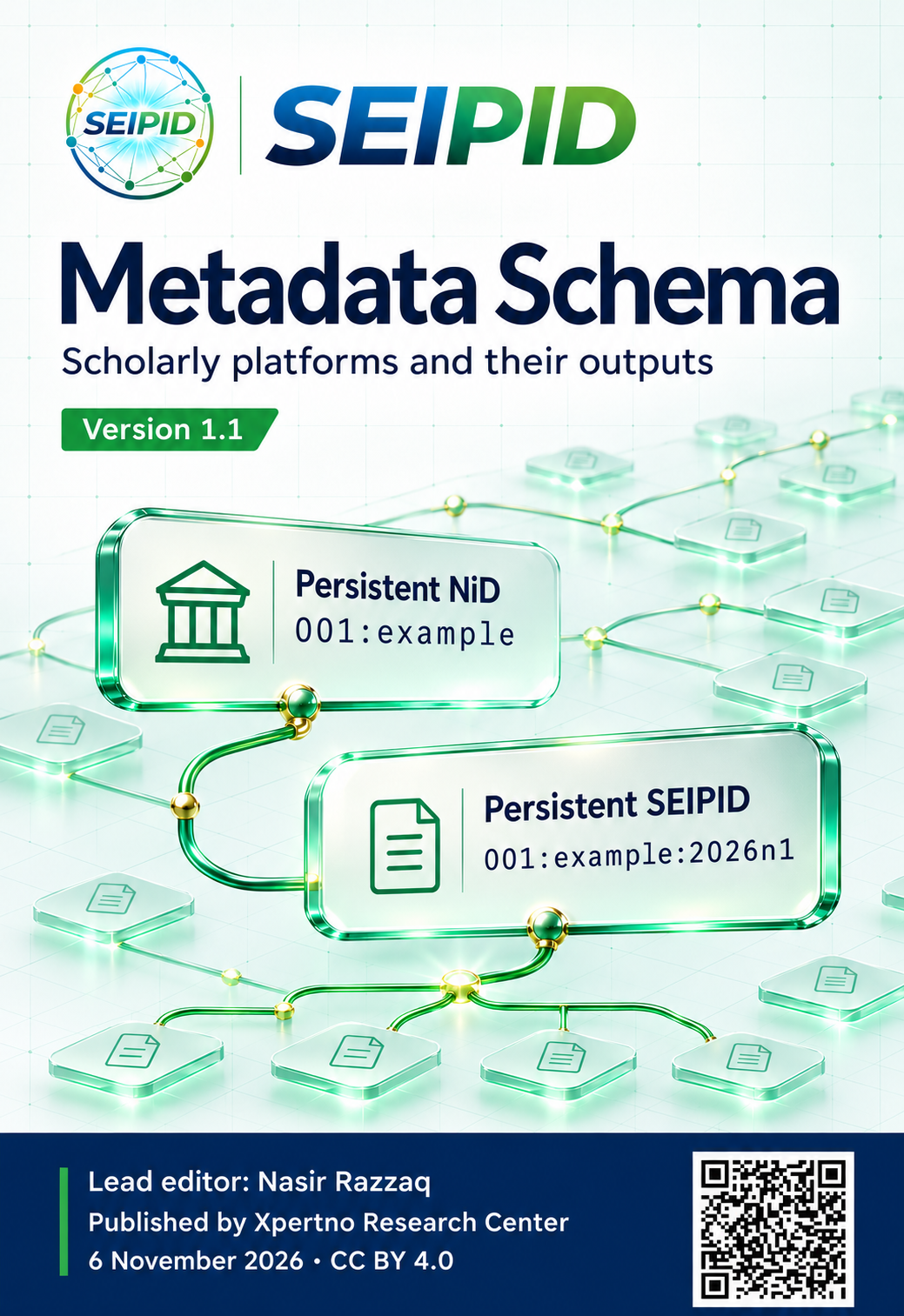
SEIPID Metadata Schema
Definitions, structures and requirements for describing scholarly platforms and their outputs consistently, supporting identification, citation, discovery, validation and metadata exchange.
Version 1.0
SEIPID: 004:xrc-ir:2026n1
Issued 6 November 2026
Lead editor: Nasir Razzaq
Xpertno Research Center
SEIPID Metadata Schema
Definitions, structures and requirements for describing scholarly platforms and their outputs consistently, supporting identification, citation, discovery, validation and metadata exchange.
Publication Detail
Contributors
Nasir Razzaq(Lead editor)

How to cite
Online version: https://seipid.com/seipid-schema/v1.0
Contents
1. Introduction
1.1 About the SEIPID Metadata Schema
SEIPID is a persistent identifier infrastructure for scholarly platforms and their outputs. The SEIPID Registry gives each registered journal, institutional repository, archive, publisher or conference organization a persistent Namespace Identifier (NiD), and each article, thesis, dataset, book, chapter or other output registered under it a persistent SEIPID.
The SEIPID Metadata Schema is the common language behind every SEIPID record. It defines each field that describes a platform or an output: what the field means, how its value is written, which values are permitted and when it is required. A platform is described once, and each output carries the platform’s persistent NiD. The same definitions apply however a record is submitted.
Metadata is supplied by the registering platform, which is responsible for its accuracy and completeness. Platforms are encouraged to provide all applicable metadata, including Recommended fields and relevant Optional fields. More complete metadata helps readers and services discover, interpret and connect scholarly platforms and their outputs.
Each registered scholarly platform and output has its own public page in the SEIPID Registry. Public metadata is also provided in machine-readable form for search engines, scholarly indexes, reference managers and AI tools. Contributor and organization identifiers connect outputs with their contributors and institutions, while references identify the works they cite. Output citations are tracked in SEIPID Rasad, and output metrics are measured in SEIPID Idraak.
The schema serves every subject and every kind of scholarly platform. It describes platforms and outputs for identification, citation and discovery; it does not replace an output’s full text or the specialist metadata a discipline may require. Account requests, platform verification and submission procedures are set out in the SEIPID Guidelines.
Metadata should be recorded in the original language of the platform or output. Where that language is not English, English versions of the title, abstract and keywords are recommended.
This document describes version 1.0 of the SEIPID Metadata Schema.
1.2 How to cite this document
SEIPID. (2026). SEIPID Metadata Schema (Version 1.0). Xpertno Research Center (SMC Pvt.) Ltd. https://seipid.com/004:xrc-ir:2026n1
1.3 How to cite registered outputs
Registered outputs may be cited in any citation style. The citation should include the output’s SEIPID as a link, written as https://seipid.com/ followed by the SEIPID.
Example (APA):
Akmal, S. (2025). Impact of graphic illustrations on English vocabulary acquisition in Pakistani dyslexic students. Xpertno International Journal of Interdisciplinary Research, 2(2), 1–19. https://seipid.com/001:xijir:2025n4
2. Metadata Field Conventions
2.1 Overview
This section sets out the conventions used to present the fields of the SEIPID Metadata Schema: requirement levels, naming and numbering, and number of values. Section 3 sets out the platform fields, which describe a registered scholarly platform, and Section 4 sets out the output fields, which describe a scholarly output registered under that platform. Each section contains tables giving the full description and requirements for each field.
2.2 Requirement levels
Each field has one of four requirement levels:
- Mandatory: the field must be present in the applicable submission or registered record. Any stated conditions determine when it applies.
- Required if it exists: the field must be provided when the information exists for that platform or output. It may be omitted only when the information does not exist.
- Recommended: the field may be omitted, but should be provided whenever possible.
- Optional: the field may be provided to give a fuller description.
Requirements apply to the specified platform or output type and the relevant stage of registration. Fields marked as assigned by the Registry are filled by the Registry at the stated stage.
Each field’s requirement level is shown in its field entry.
2.3 Naming and numbering
Each field has a readable name, a permanent field reference number and a public JSON key.
- The name describes the information the field holds, for example Output Original Title.
- The field reference number identifies the field independently of its name or position in this document. Platform fields are numbered P1, P2, P3 and so on. Output fields are numbered O1, O2, O3 and so on.
- Where a field consists of several parts, each part is numbered under the field. For example, Output Contributors is O18, Output Contributor Name is O18.2 and Output Contributor Role is O18.3. A part that has its own parts continues the same pattern: Output Contributor Given Names is O18.2.1.
- The public JSON key is the case-sensitive name used to represent the field in JSON, for example
outputOriginalTitle. It is shown with the field’s description. - Identifier fields use the identifier’s own name as their JSON key, for example
nid,seipid,xpenid,orcidandror.
Field reference numbers are separate from document section numbers and public JSON keys. Rules for changes in later versions are set out in Section 10.
2.4 Number of values
Each field states how many values it may hold:
- One value: at most one value may be supplied.
- Multiple values allowed: more than one value may be supplied, subject to the field's stated limits.
Whether a field may be omitted is determined by its requirement level and any applicable conditions. A field with multiple values may also set a minimum or maximum number, for example up to three disciplines, or three to seven keywords.
Output Original Title is Mandatory with one value, so every applicable output record has exactly one original title. Output Contributors is Mandatory with multiple values allowed, so every applicable output record has at least one contributor, and more may be added.
3. Platform Metadata
3.1 Overview
This section defines the metadata describing a registered scholarly platform. Table 1 contains the fields for every platform. Table 2 contains the fields that apply to particular platform types.
3.2 Field descriptions: every platform (P1 to P27.7)
| No. | Field | Definition | Value specification |
|---|---|---|---|
| P1 | Platform NiD
Key: nid
| The persistent identifier of the registered scholarly platform. | Format: Registration number of three or more digits, a colon, and the platform abbreviation in lower case with its type ending The Registry assigns the NiD when the platform is approved. The submitter does not supply it. The type ending is: none for a journal, -ir for an institutional repository, -arch for an archive, -p for a publisher and -conf for a conference organization. A NiD is never reassigned to another platform, including when management of the platform changes. Example: 001:xijir; 014:example-ir |
| P2 | Platform Status
Key: platformStatus
| The current standing of the platform in the Registry. | Format: Controlled value The Registry sets and updates the status. A platform reports when it ceases publication or merges with another platform. A NiD is never deleted, and its public page remains available whatever its status. When the status is Merged, P26 identifies the platform it merged into; when it is Renamed, P26 identifies the new NiD. Allowed values: see list 5.1. Example: Active |
| P3 | Platform Registration Date
Key: platformRegistrationDate
| The date the Registry issued the platform’s NiD. | Format: Date, YYYY-MM-DD Set when the NiD is issued and never changed. For a NiD issued after a change of title or abbreviation, this is the date of the change. Example: 2026-05-14 |
| P4 | Platform Status Date
Key: platformStatusDate
| The date the current status took effect. | Format: Date, YYYY-MM-DD The Registry updates it whenever P2 changes. Example: 2026-05-14 |
| P5 | Platform Type
Key: platformType
| The main category of the scholarly platform. | Format: Controlled value Select the category that describes the platform’s main function. The type decides the subtypes available in P6, the fields in Table 2 that apply, and the content types its outputs may use. Allowed values: see list 5.2. Example: Journal |
| P6 | Platform Subtype
Key: platformSubtype
| The more specific category of the platform within its type. | Format: Controlled value Select one subtype listed under the chosen type. Choose by the platform’s main function, not by its subject coverage. Allowed values: see list 5.3. Example: Interdisciplinary Journal |
| P7 | Platform Original Title
Key: platformOriginalTitle
| The full title of the platform in its original language. | Format: Text Record the title exactly as the platform publicly uses it, keeping its language and script. Record an English translation in P9 and any other or former title in P10. Example: Xpertno International Journal of Interdisciplinary Research |
| P8 | Platform Abbreviation
Key: platformAbbreviation
| The short form of the platform’s title, usually the initial letters of its main words. | Format: Letters and digits, 2–15 characters Supply the platform’s own abbreviation. Example: XIJIR |
| P9 | Platform English Translated Title
Key: platformEnglishTranslatedTitle
| An English translation of the platform’s original title. | Format: Text, English Translate the original title faithfully; do not create a new name. Omit when the original title is already in English. Example: Journal of Linguistic Research (original title in Urdu) |
| P10 | Platform Other or Former Title
Key: platformOtherOrFormerTitle
| An alternative title, or a previous title, used by the same platform. | Format: Text Supply one alternative or former title. When a registered platform changes its title or abbreviation, it receives a new NiD; the Registry records the previous title here on the new record and links the two NiDs through P26. Example: Journal of Language Studies |
| P11 | Platform Website
Key: platformWebsite
| The official public website of the platform. | Format: HTTPS URL Supply the platform’s own canonical home page, verified for this platform during registration. Do not use a social media page, or the organization’s general home page when the platform has its own site. Example: https://journal.example.org |
| P12 | Platform Contact Email
Key: platformContactEmail
| The public address for official correspondence with the platform. | Format: Email address Use a monitored address authorized for platform correspondence. It is public, and separate from contributor email (O18.9), which is restricted. Example: [email protected] |
| P13 | Platform Country
Key: platformCountry
| The country where the platform’s responsible office is based. | Format: Country (ISO 3166-1 code) Record the office that runs the platform, not the location of its hosting server. Example: Pakistan (PK) |
| P14 | Platform City
Key: platformCity
| The city where the platform’s responsible office is based. | Format: Text Record the city of the same office as P13. Example: Islamabad |
| P15 | Platform Establishment Year
Key: platformEstablishmentYear
| The year in which the platform was established. | Format: Four-digit year Use the documented founding year. Do not use the year of SEIPID registration. Example: 2023 |
| P16 | Platform Short Description
Key: platformShortDescription
| A brief factual account of the platform’s purpose, content and audience. | Format: Text, 50–800 characters Write a plain factual description without promotional claims, rankings or unverified indexing statements. Example: A diamond open access journal publishing research on language, education and society. |
| P17 | Platform Content Languages
Key: platformContentLanguages
| The languages of the scholarly content the platform publishes, deposits or preserves. | Format: Language codes (BCP 47) Supply at least one language. Describe the content, not the language of the website. Example: en; ur |
| P18 | Platform Subject Group
Key: platformSubjectGroup
| The broad knowledge area the platform covers. | Format: Controlled value Select one group. Use Multidisciplinary or Interdisciplinary when the platform covers several areas. Allowed values: see list 5.18. Example: Interdisciplinary |
| P19 | Platform Disciplines
Key: platformDisciplines
| The defined fields of study within the platform’s subject group. | Format: Controlled values Select 1 to 3 disciplines from the discipline list. They must belong to the selected group. For Multidisciplinary or Interdisciplinary, they may come from different groups. Select none when the group is Other. Allowed values: see list 5.19. Example: Languages, Linguistics and Literature; Education |
| P20 | Platform Subjects
Key: platformSubjects
| Specific topics the platform covers, each within one of its disciplines. | Format: Subject term + discipline Supply up to 3 topics, each linked to one of the disciplines selected in P19. Example: Applied linguistics (Languages, Linguistics and Literature) |
| P21 | Platform Content Licence
Key: platformContentLicence
| The licence under which the platform usually provides its content. | Format: Controlled value Select the licence that normally applies. A work under a different licence records its own licence in O24. Allowed values: see list 5.20. Example: CC BY 4.0 |
| P22 | Platform Content Copyright Holder
Key: platformContentCopyrightHolder
| Who normally holds copyright in the platform’s content. | Format: Holder category + name Select the usual holder category and give the holder’s name where known. A work with a different holder records it in O25. Allowed values: see list 5.21. Example: Author / Creator |
| P23 | Platform Content Access Model
Key: platformContentAccessModel
| The access conditions that normally apply to the platform’s content. | Format: Controlled value Select the usual model. It describes access for readers, not charges to authors, which are recorded in P34. A work with different access records it in O23. When the model is Open access and P34 is No fee, the Registry shows the platform as Diamond open access. Allowed values: see list 5.22. Example: Open access |
| P24 | Platform Reference Style
Key: platformReferenceStyle
| The citation style the platform uses for references in its content. | Format: Style name + edition Name one style and its edition where known. Each work’s references are recorded as published, in O34. Example: APA, 7th edition |
| P25 | Platform External Links
Key: platformExternalLinks
| Links to the platform’s own records or official profiles on other services. | Format: Service + HTTPS URL Each entry gives one service and one link to the platform’s own record or profile on that service, not to a search page. Allowed services: see list 5.10. Example: OpenAlex + link to the platform’s OpenAlex record |
| P26 | Platform Related Platforms
Key: platformRelatedPlatforms
| Other platforms connected to this platform by continuation or merger. | Format: Relation + NiD Each entry gives one relation and the related platform’s NiD. Give the title and website only when the related platform has no NiD. When P2 is Merged, a “Merged into” entry is required; when P2 is Renamed, a “Continued by” entry is required. Allowed relations: see list 5.5. Example: Merged into 001:example |
| P27 | Platform Organization
Key: platformOrganization
| The organization responsible for publishing or managing the platform. | Format: Group of parts Identify the publisher or managing organization, not the person or account submitting the record. Its details are given in P27.1–P27.7. Example: see P27.1–P27.7 |
| P27.1 | Platform Organization Name
Key: platformOrganizationName
| The full official name of the organization. | Format: Text Use the name as legally or publicly used, without abbreviations. Example: Xpertno Research Center (SMC-Private) Limited |
| P27.2 | Platform Organization Type
Key: platformOrganizationType
| The kind of organization. | Format: Controlled value Select the category that best describes the organization. Allowed values: see list 5.4. Example: University or college |
| P27.3 | Platform Organization Website
Key: platformOrganizationWebsite
| The official website of the organization. | Format: HTTPS URL Supply the organization’s own home page. It may differ from P11. Example: https://www.example.org |
| P27.4 | Platform Organization Country
Key: platformOrganizationCountry
| The country where the organization is based. | Format: Country (ISO 3166-1 code) Record it even when it is the same as P13. Example: Pakistan (PK) |
| P27.5 | Platform Organization City
Key: platformOrganizationCity
| The city where the organization is based. | Format: Text Record it even when it is the same as P14. Example: Islamabad |
| P27.6 | Platform Organization Office Address
Key: platformOrganizationOfficeAddress
| The official office or postal address of the organization. | Format: Text Give the full address, including the street or building and the postal code where used. Example: Building 12, Example Road, Lahore 54000 |
| P27.7 | Platform Organization ROR
Key: ror
| The ROR identifier of the organization. | Format: https://ror.org/ + identifier Supply the canonical ROR link when the organization has one. It must identify the organization named in P27.1. Example: https://ror.org/0abcde123 |
3.3 Field descriptions: platform-specific fields (P28 to P52)
| No. | Field | Definition | Value specification |
|---|---|---|---|
| P28 | Platform ISSN and eISSN
Key: issn
| The ISSNs assigned to the journal’s print and electronic editions. | Format: ISSN + edition Supply each ISSN that has been assigned, marked as print or electronic. Never invent or borrow an ISSN. Example: 3005-8457 (electronic) |
| P29 | Platform Publication Model
Key: platformPublicationModel
| How the journal releases its published content. | Format: Controlled value Select how content is released. This is separate from the access model. Allowed values: see list 5.6. Example: Continuous |
| P30 | Platform Publication Frequency
Key: platformPublicationFrequency
| How often the journal publishes issues. | Format: Controlled value State the real schedule. Not used for a continuous-only journal. Allowed values: see list 5.7. Example: Quarterly |
| P31 | Platform First Publication Date
Key: platformFirstPublicationDate
| The date the journal first published scholarly content. | Format: Date: YYYY-MM-DD, YYYY-MM or YYYY Use the most exact date known. It may differ from P15. Example: 2023 |
| P32 | Platform Editor in Chief
Key: platformEditorInChief
| The person or persons with chief editorial responsibility for the journal. | Format: Name + affiliation Give each editor in chief’s name and affiliation as publicly stated. List joint editors separately. Example: A. Rahman, University of Example |
| P33 | Platform Peer Review Type
Key: platformPeerReviewType
| The review model the platform applies to its scholarly content. | Format: Controlled value Select the model actually used. For a journal, the public peer review policy (P35.6) explains the process and any exceptions. Allowed values: see list 5.8. Example: Double blind |
| P34 | Platform Author Fees
Key: platformAuthorFees
| The charges the journal makes to authors to submit or publish. | Format: Fee type + amount + currency Select No fee, or give each charge with its type, amount and currency. Charges to readers are not recorded here. Waivers are explained in the author fees policy (P35.2). Allowed values: see list 5.9. Example: No fee |
| P35 | Platform Policy Links
Key: platformPolicyLinks
| Public links to the journal’s own published policies. | Format: Group of parts Supply a link for each Mandatory policy in P35.1–P35.11, and for P35.12–P35.15 where the journal has them. One page may serve several policies if each policy can be clearly found on it. Each link must lead to the journal’s own published page. Example: https://journal.example.org/policies/peer-review |
| P35.1 | Platform Copyright and Licence Policy
Key: platformCopyrightAndLicencePolicy
| Who keeps copyright, which reuse licences apply, and how permissions are handled. | Format: HTTPS URL Link to the journal’s own published policy. |
| P35.2 | Platform Author Fees Policy
Key: platformAuthorFeesPolicy
| All charges to authors, their amounts, currency and when they are paid, or a statement that there are none, with any waivers. | Format: HTTPS URL Link to the journal’s own published policy. |
| P35.3 | Platform Ethics Policy
Key: platformEthicsPolicy
| The journal’s research and publication ethics expectations, and how suspected misconduct is handled. | Format: HTTPS URL Link to the journal’s own published policy. |
| P35.4 | Platform Editorial Board
Key: platformEditorialBoard
| The names, roles and affiliations of the editorial board, including the editor in chief. | Format: HTTPS URL Link to the journal’s own current editorial board page. |
| P35.5 | Platform Author Instructions
Key: platformAuthorInstructions
| Who may submit, how to prepare a manuscript, the declarations required and the submission process. | Format: HTTPS URL Link to the journal’s own published instructions. |
| P35.6 | Platform Peer Review Policy
Key: platformPeerReviewPolicy
| The review model, how reviewers are chosen, who decides, expected timescales and any exceptions by content type. | Format: HTTPS URL Link to the journal’s own published policy. |
| P35.7 | Platform Plagiarism Policy
Key: platformPlagiarismPolicy
| How plagiarism concerns are checked and what follows a confirmed finding. | Format: HTTPS URL Link to the journal’s own published policy. |
| P35.8 | Platform AI Use Policy
Key: platformAiUsePolicy
| Permitted uses of AI tools, and the disclosure duties of authors, reviewers and editors. | Format: HTTPS URL Link to the journal’s own published policy. |
| P35.9 | Platform Conflicts of Interest Policy
Key: platformConflictsOfInterestPolicy
| How interests are disclosed, and how editorial and reviewer conflicts are managed. | Format: HTTPS URL Link to the journal’s own published policy. |
| P35.10 | Platform Corrections and Retractions Policy
Key: platformCorrectionsAndRetractionsPolicy
| How errors, corrections, withdrawals and retractions are handled, and how notices stay linked to the works they concern. | Format: HTTPS URL Link to the journal’s own published policy. |
| P35.11 | Platform Archiving Policy
Key: platformArchivingPolicy
| The arrangements for continued access to the journal’s content if it stops publishing. | Format: HTTPS URL or “Not arranged yet” Link to the policy, or declare “Not arranged yet”. The declaration is not an archiving arrangement. |
| P35.12 | Platform Complaints and Appeals Policy
Key: platformComplaintsAndAppealsPolicy
| How to make a complaint or appeal against an editorial decision. | Format: HTTPS URL Link to the journal’s own published policy. |
| P35.13 | Platform Data Sharing Policy
Key: platformDataSharingPolicy
| Expectations for supporting data, repositories, access limits and data availability statements. | Format: HTTPS URL Link to the journal’s own published policy. |
| P35.14 | Platform Aims and Scope
Key: platformAimsAndScope
| The subjects covered, the intended readers and the types of contribution considered. | Format: HTTPS URL Link to the journal’s own published page. |
| P35.15 | Platform Editorial Office Address
Key: platformEditorialOfficeAddress
| The journal’s public contact page giving its editorial office address. | Format: HTTPS URL Link to the journal’s official contact page. |
| P36 | Platform Indexing Links
Key: platformIndexingLinks
| Links to the journal’s own records in indexes and directories. | Format: Index name + HTTPS URL Each entry gives one index and one link to the journal’s own record in it. A listing must not suggest any status beyond what the index record shows. Allowed services: see list 5.10. Example: AlifIndex + link to the journal’s record |
| P37 | Platform Repository Content Types
Key: platformRepositoryContentTypes
| The kinds of material the repository holds. | Format: Content type values Select each content type the repository registers, from the content types allowed for repositories. Allowed values: see list 5.12. Example: Thesis; Dissertation; Dataset |
| P38 | Platform Repository Software
Key: platformRepositorySoftware
| The software that runs the repository. | Format: Text Name the software and its version. Example: DSpace 7.6 |
| P39 | Platform OAI-PMH Address
Key: platformOaiPmhAddress
| The base address of the platform’s OAI-PMH service, which other systems use to collect its records automatically. | Format: HTTPS URL Supply the base URL that answers OAI-PMH requests. Example: https://repository.example.edu/oai/request |
| P40 | Platform Repository Policy Links
Key: platformRepositoryPolicyLinks
| Public links to the repository’s own policies. | Format: Group of parts Supply one link for each policy in P40.1–P40.3. |
| P40.1 | Platform Deposit Policy
Key: platformDepositPolicy
| Who may deposit material, what may be deposited, and how. | Format: HTTPS URL Link to the repository’s own published policy. |
| P40.2 | Platform Preservation Policy
Key: platformPreservationPolicy
| How long, and by what means, the repository keeps its content available. | Format: HTTPS URL Link to the repository’s own published policy. |
| P40.3 | Platform Metadata Reuse Policy
Key: platformMetadataReusePolicy
| The terms on which others may reuse the repository’s metadata. | Format: HTTPS URL Link to the repository’s own published policy. |
| P41 | Platform Coverage Period
Key: platformCoveragePeriod
| The time span covered by the archive’s holdings. | Format: Date range Give the period of the material held, not the archive’s founding date. Example: 1947–1990 |
| P42 | Platform Holdings Format
Key: platformHoldingsFormat
| The physical or digital formats the archive holds. | Format: Text values List the formats actually preserved. Example: Manuscripts; Photographs; Audio recordings |
| P43 | Platform Approximate Holdings
Key: platformApproximateHoldings
| An estimate of the amount of material the archive holds. | Format: Quantity + unit + date Give the quantity, the unit and the date of the estimate. Example: About 12,000 items (2026) |
| P44 | Platform Access Conditions
Key: platformAccessConditions
| How the public can use the archive’s holdings. | Format: Text State whether material is available online, on site or by appointment, and any conditions that apply. Example: Catalogue online; originals on site by appointment |
| P45 | Platform Finding Aids Link
Key: platformFindingAidsLink
| A link to the archive’s catalogue, inventory or finding aid. | Format: HTTPS URL Link to the archive’s own public catalogue. Example: https://archive.example.org/catalogue |
| P46 | Platform ISBN Prefix
Key: platformIsbnPrefix
| The ISBN prefix assigned to the publisher. | Format: ISBN prefix Supply each prefix the publisher has been assigned. It does not replace the ISBN of each book, which is recorded in O28. Example: 978-1-23456 |
| P47 | Platform Editorial Board Link
Key: platformEditorialBoardLink
| The public page listing the publisher’s editorial board. | Format: HTTPS URL Link to the publisher’s own current page. |
| P48 | Platform Committee Links
Key: platformCommitteeLinks
| Public pages listing the organizing or scientific committees. | Format: HTTPS URL Link to the organization’s official committee pages. |
| P49 | Platform Series Name
Key: platformSeriesName
| The name of each recurring conference series the organization runs. | Format: Text Keep the organization, the series and each event distinct. Individual events are recorded as outputs. Example: International Conference on Language and Education |
| P50 | Platform Conference Frequency
Key: platformConferenceFrequency
| How often the conference series usually takes place. | Format: Text State the usual interval. It is not a promise of future events. Example: Annual |
| P51 | Platform First Event Year
Key: platformFirstEventYear
| The year of the first event in the conference series. | Format: Four-digit year Use the year the first event took place. It may differ from P15. Example: 2019 |
| P52 | Platform Proceedings ISSN or ISBN
Key: platformProceedingsIdentifiers
| The ISSN of the conference’s proceedings series, or the ISBNs of its proceedings volumes. | Format: ISSN or ISBN + type Supply each identifier that has been assigned. Never invent one. Example: ISSN 1234-5679 |
4. Output Metadata
4.1 Overview
This section defines the metadata describing a scholarly output registered under a platform. Table 3 contains the fields for every output. Table 4 contains the fields that apply to particular content types. Requirements specific to a content type are set out in Section 6. Some output fields are filled from the platform record and may be changed for an individual output.
4.2 Field descriptions: every output (O1 to O35)
| No. | Field | Definition | Value specification |
|---|---|---|---|
| O1 | Output NiD
Key: nid
| The persistent NiD of the platform under which the output is registered. | Format: Assigned NiD The NiD of the platform registering the output. The output’s content type must be permitted for that platform’s type. Example: 001:xijir |
| O2 | Output SEIPID
Key: seipid
| The persistent identifier of the registered scholarly output. | Format: The NiD, a colon and a suffix assigned by the Registry. The suffix is the publication year, a letter and a running number: n for most outputs (2025n4), b for books (2026b1) and e for events (2026e1). A chapter adds c and its chapter number to its book’s suffix (2026b1c4); a contribution adds c and a running number to its event’s suffix (2026e1c3). An archive uses the year of registration and pid (2026pid15). The Registry assigns the SEIPID when the output is registered. The submitter does not supply it. A SEIPID is never reassigned to another output and is never deleted. Example: 001:xijir:2025n4 |
| O3 | Output Status
Key: outputStatus
| The current standing of the output in the Registry. | Format: Controlled value The Registry sets and updates the status. Retracted or Withdrawn is set only when the notice is linked in O33 or confirmed by the platform. Replaced is set when a newer record identifies this one with Replaces in O33. Removed is set only by SEIPID. When more than one applies, the first in this order is used: Removed, Retracted, Withdrawn, Replaced. The record and its public page remain available, marked with the status. Allowed values: see list 5.11. Example: Active |
| O4 | Output Content Type
Key: outputContentType
| The category that describes the nature of the output. | Format: Controlled value Select one content type permitted for the platform’s type (P5). The content type decides which fields in Table 4 apply and which content-type requirements must be met. Allowed values: see list 5.12. Example: Research Article |
| O5 | Output Language
Key: outputLanguage
| The principal language or languages of the output. | Format: Language codes (BCP 47) Give the language of the output itself, not of its translated metadata. A dataset or software output may omit it when no natural language applies. Example: en |
| O6 | Output Original Title
Key: outputOriginalTitle
| The complete title of the output in its original language, as published. | Format: Text Keep the spelling, script and meaning as published. Record a separately published subtitle in O7. Example: Impact of Graphic Illustrations on English Vocabulary Acquisition in Pakistani Dyslexic Students |
| O7 | Output Subtitle
Key: outputSubtitle
| The additional title statement published with the main title. | Format: Text Keep it separate from the main title. Do not create a subtitle by splitting an ordinary title. |
| O8 | Output Short Title
Key: outputShortTitle
| A concise English title used for search results and shared-link previews. | Format: Text, 1–59 characters Supply it when the original title is over 59 characters, counting spaces and punctuation. Keep the meaning of the full title, which is still recorded in O6. Example: Graphic Illustrations for Dyslexic Learners |
| O9 | Output English Translated Title
Key: outputEnglishTranslatedTitle
| An English translation of a title published in another language. | Format: Text, English Keep the meaning of the original title. The translation does not replace the original title. |
| O10 | Output English Translated Subtitle
Key: outputEnglishTranslatedSubtitle
| An English translation of a subtitle published in another language. | Format: Text, English Supply only when the output has a subtitle in O7. |
| O11 | Output Abstract or Description
Key: outputAbstractOrDescription
| A substantive summary of the output’s content or purpose. | Format: Text with language code Use the published abstract where one exists; otherwise give an accurate description. A title alone is not a description. When the output publishes abstracts in more than one language, give each with its language. |
| O12 | Output English Translated Abstract or Description
Key: outputEnglishTranslatedAbstractOrDescription
| An English translation of the original abstract or description. | Format: Text, English Keep the original text in O11. Do not add findings that are not in the original. |
| O13 | Output Keywords
Key: outputKeywords
| Terms in the output’s original language describing its main topics. | Format: Text terms Supply 3 to 7 distinct keywords. Keep each term separate. Example: dyslexia; vocabulary acquisition; graphic illustrations |
| O14 | Output English Translated Keywords
Key: outputEnglishTranslatedKeywords
| English equivalents of the original keywords. | Format: Text terms, English Keep the original terms in O13 alongside their translations. |
| O15 | Output Subject Group
Key: outputSubjectGroup
| The broad knowledge area of the output. | Format: Controlled value Select one group. Use Multidisciplinary or Interdisciplinary when the output covers several areas. Allowed values: see list 5.18. Example: Humanities and the Arts |
| O16 | Output Disciplines
Key: outputDisciplines
| The defined fields of study of the output within its subject group. | Format: Controlled values Select 1 to 3 disciplines from the discipline list. They must belong to the selected group. For Multidisciplinary or Interdisciplinary, they may come from different groups. Select none when the group is Other. Allowed values: see list 5.19. Example: Languages, Linguistics and Literature |
| O17 | Output Subjects
Key: outputSubjects
| Specific topics of the output, each within one of its disciplines. | Format: Subject term + discipline Supply up to 3 topics, each linked to one of the disciplines in O16. Example: Applied linguistics (Languages, Linguistics and Literature) |
| O18 | Output Contributors
Key: outputContributors
| The people or organizations credited with responsibility for the output, in published order. | Format: Ordered group of parts Include every author in publication order, and other credited contributors with their actual roles. At least one contributor is required. Each contributor’s details are given in O18.1–O18.9. |
| O18.1 | Output Contributor Type
Key: outputContributorType
| Whether the contributor is a person or an organization. | Format: Controlled value Applies to every contributor. A group author is an organization. Allowed values: see list 5.13. Example: Person |
| O18.2 | Output Contributor Name
Key: outputContributorName
| The contributor’s name as credited on the output. | Format: Text For a person, the Registry builds the name from O18.2.1 and O18.2.2. For an organization, enter its full credited name. Example: Saba Akmal |
| O18.2.1 | Output Contributor Given Names
Key: outputContributorGivenNames
| The person’s given name or names. | Format: Text Leave it empty when the person uses a single name. Do not invent a given name. Example: Saba |
| O18.2.2 | Output Contributor Family Name
Key: outputContributorFamilyName
| The person’s family name, or their only name. | Format: Text A person with a single name records it here. Example: Akmal |
| O18.3 | Output Contributor Role
Key: outputContributorRole
| The capacity in which the contributor took part. | Format: Controlled value Select the contributor’s actual role. A contributor’s position in the list is separate from the role and from CRediT roles. Allowed values: see list 5.14. Example: Author |
| O18.4 | Output Contributor CRediT Roles
Key: outputContributorCreditRoles
| The specific research contributions credited to the contributor, using the CRediT taxonomy. | Format: Controlled values Select one or more of the 14 CRediT roles. Several contributors may share a role. These roles do not decide author order or authorship. Allowed values: see list 5.15. Example: Conceptualization; Methodology |
| O18.5 | Output Corresponding Author
Key: outputCorrespondingAuthor
| The author designated to handle correspondence about the output. | Format: Yes on one listed author Mark exactly one author. A sole author is the corresponding author automatically. Do not make a non-author the corresponding author. |
| O18.6 | Output Contributor Affiliation
Key: outputContributorAffiliation
| The organization with which the person was associated for this output. | Format: Group of parts Give the affiliation stated in the output, not the person’s later employment. A person with no affiliation is recorded as “Independent researcher”. Do not invent an institution. Details are given in O18.6.1–O18.6.4. |
| O18.6.1 | Output Affiliation Name
Key: outputAffiliationName
| The name of the affiliated organization. | Format: Text Use the organization’s full name, or “Independent researcher”. Example: University of Example |
| O18.6.2 | Output Affiliation Department
Key: outputAffiliationDepartment
| The department or unit within the affiliated organization. | Format: Text Give the department stated in the output. Example: Department of English |
| O18.6.3 | Output Affiliation Country
Key: outputAffiliationCountry
| The country of the affiliated organization. | Format: Country (ISO 3166-1 code) For an independent researcher, give the country where the research was carried out. This field does not record nationality. Example: Pakistan (PK) |
| O18.6.4 | Output Affiliation ROR
Key: ror
| The ROR identifier of the affiliated organization. | Format: https://ror.org/ + identifier Supply the canonical ROR link for the organization in O18.6.1. Never assign an organization’s ROR to a person. |
| O18.7 | Output Contributor XPENID
Key: xpenid
| The contributor’s persistent XPENID. | Format: XPENID, such as SA-XPEN2025-0057 Supply the contributor’s own XPENID where one exists. It is not a condition of authorship. Example: SA-XPEN2025-0057 |
| O18.8 | Output Contributor ORCID iD
Key: orcid
| The persistent ORCID identifier of a person. | Format: https://orcid.org/ + identifier Supply the person’s own ORCID link. Never use an ORCID iD for an organization. Example: https://orcid.org/0000-0002-1825-0097 |
| O18.9 | Output Contributor Email
Key: outputContributorEmail
| An email address for correspondence with the contributor and for identity matching. | Format: Email address Restricted. It is never shown on public pages or included in public metadata, feeds or exports. It is separate from the platform’s public contact address (P12). Example: [email protected] |
| O19 | Output Publication Date
Key: outputPublicationDate
| The date on which the output was published or made available by its source. | Format: Date: YYYY-MM-DD, YYYY-MM or YYYY Use the date of the output, not the date of SEIPID registration. Use only the precision known; explain uncertain dates in O20.14. Example: 2025-05-15 |
| O20 | Output Other Dates
Key: outputOtherDates
| Further dates in the life of the output. | Format: Group of parts Each date is given in its own part, O20.1–O20.14. Use only the precision known. |
| O20.1 | Output Submitted Date
Key: outputSubmittedDate
| The date the output was submitted for publication or review. | Format: Date Record the date of first submission to this platform. Example: 2025-01-10 |
| O20.2 | Output Revised Dates
Key: outputRevisedDates
| The dates on which revised versions were submitted. | Format: Dates List the dates in time order. |
| O20.3 | Output Accepted Date
Key: outputAcceptedDate
| The date the output was accepted for publication. | Format: Date Record the actual acceptance date. Do not infer it from the publication date. Example: 2025-04-02 |
| O20.4 | Output Online First Date
Key: outputOnlineFirstDate
| The date of online publication before a volume or issue was assigned. | Format: Date For a journal item without a volume, this date allows O36 to stay empty until the volume is assigned. |
| O20.5 | Output Posted Date
Key: outputPostedDate
| The date the output was posted, such as a preprint. | Format: Date Record the date the source first posted it. |
| O20.6 | Output Available Date
Key: outputAvailableDate
| The date the output became available to readers, where this differs from publication. | Format: Date Use only when availability differs from O19. |
| O20.7 | Output Created Date
Key: outputCreatedDate
| The date the resource itself was created. | Format: Date Use for datasets, software, media and archival material. |
| O20.8 | Output Updated Date
Key: outputUpdatedDate
| The date the resource itself was last updated. | Format: Date Describes a change to the resource, not to its SEIPID record. |
| O20.9 | Output Collected Date
Key: outputCollectedDate
| The date or period in which material or data was collected. | Format: Date or date range Give a start and end when collection took place over a period. |
| O20.10 | Output Embargo End Date
Key: outputEmbargoEndDate
| The date on which an access embargo ends. | Format: Date The date alone does not change O23. Update the access model when access actually changes. |
| O20.11 | Output Copyright Year
Key: outputCopyrightYear
| The year stated in the output’s copyright notice. | Format: Four-digit year Use the year as published. |
| O20.12 | Output Retracted Date
Key: outputRetractedDate
| The date the retraction of the output was published. | Format: Date Record it with the retraction notice. The date alone does not change O3. |
| O20.13 | Output Withdrawn Date
Key: outputWithdrawnDate
| The date the output was withdrawn. | Format: Date Record it with the withdrawal notice. The date alone does not change O3. |
| O20.14 | Output Date Note
Key: outputDateNote
| An explanation of a date’s precision, uncertainty or meaning. | Format: Text Use for approximate or historical dates. Never invent a day or month to make a date look complete. Example: Publication year known; month and day not recorded. |
| O21 | Output Target Page Link
Key: outputTargetPageLink
| The source page for this specific output. | Format: HTTPS URL Give the page of this output, not the platform’s home page or a private session link. Keep it current. Example: https://journal.example.org/article/view/123 |
| O22 | Output PDF Link
Key: outputPdfLink
| A direct link to a PDF of the output. | Format: HTTPS URL Supply only when a PDF exists. The link must respect the output’s access conditions. Example: https://journal.example.org/article/download/123.pdf |
| O23 | Output Access Model
Key: outputAccessModel
| The conditions under which the output itself can be accessed. | Format: Controlled value Filled from P23. Change it when this output differs. A public SEIPID record does not mean the full text is open. Allowed values: see list 5.22. Example: Open access |
| O24 | Output Licence
Key: outputLicence
| The terms under which the output may be reused. | Format: Controlled value Filled from P21. Change it when this output differs. Give the exact licence version. For a custom licence, supply its text or link. Use Unknown when there is no evidence; never invent permission. Allowed values: see list 5.20. Example: CC BY 4.0 |
| O25 | Output Copyright Holder
Key: outputCopyrightHolder
| Who holds copyright in the output, or its stated copyright status. | Format: Holder category + name Filled from P22. Change it when this output differs. Give the holder’s name where known. Allowed values: see list 5.21. Example: Author / Creator; Saba Akmal |
| O26 | Output Reader Price
Key: outputReaderPrice
| The price a reader pays to access or buy this output. | Format: Description + amount + currency State what the price covers, its amount and currency. Charges to authors are recorded in P34, not here. Example: Full-text access; 10.00; USD |
| O27 | Output Peer Reviewed
Key: outputPeerReviewed
| Whether this output underwent peer review. | Format: Yes or No Filled from P33. The value must describe this output; not every item in a peer-reviewed journal is reviewed, such as editorials. Omission means not stated. Example: Yes |
| O28 | Output Other Identifiers
Key: outputOtherIdentifiers
| Identifiers given to the same output by other systems. | Format: Group of parts Record every identifier the output has, such as a DOI or ISBN, with its type in O28.1 and value in O28.2. An ISBN of a parent book belongs to the book, not to its chapter. |
| O28.1 | Output Identifier Type
Key: outputIdentifierType
| The scheme of the identifier. | Format: Controlled value Select the scheme. Allowed values: see list 5.16. Example: DOI |
| O28.2 | Output Identifier Value
Key: outputIdentifierValue
| The identifier itself. | Format: Text Give the exact value as issued by its scheme. Example: 10.1234/example.2025.4 |
| O29 | Output Funding
Key: outputFunding
| The financial support acknowledged for producing the output. | Format: Group of parts Give one entry for each funder or award. Do not infer funding from an affiliation. Details are given in O29.1–O29.3. |
| O29.1 | Output Funder Name
Key: outputFunderName
| The name of the funding organization. | Format: Text Use the funder’s full official name. Example: Example Research Foundation |
| O29.2 | Output Funder ROR
Key: ror
| The ROR identifier of the funder. | Format: https://ror.org/ + identifier Supply the canonical ROR link for the funder in O29.1. |
| O29.3 | Output Award Number
Key: outputAwardNumber
| The grant or award number given by the funder. | Format: Text Give the number exactly as issued. Example: ERF-2025-117 |
| O30 | Output Data Availability
Key: outputDataAvailability
| Whether and how the data supporting the output can be accessed. | Format: Controlled value Select the option that matches the output’s published statement. Omission means not stated; it does not mean no data exist. Allowed values: see list 5.23. Example: Openly available in a public repository |
| O31 | Output Ethics Status
Key: outputEthicsStatus
| The ethical approval status of the research reported in the output. | Format: Controlled value Select the status stated in the output. Allowed values: see list 5.24. Example: Approved by an ethics committee / IRB |
| O32 | Output Competing Interests
Key: outputCompetingInterests
| Whether the output declares competing interests. | Format: Controlled value Select the option stated in the output. Do not select “No competing interests” when the output makes no statement. Allowed values: see list 5.25. Example: No competing interests |
| O33 | Output Related Works
Key: outputRelatedWorks
| Links between this output and other identified works. | Format: Group of parts Each entry gives a relation type (O33.1) and the related work’s identifier (O33.2). A correction must link the work it corrects; a retraction notice must link the work it retracts. |
| O33.1 | Output Relation Type
Key: outputRelationType
| How this output relates to the other work. | Format: Controlled value Select the relation. Allowed values: see list 5.17. Example: Corrects |
| O33.2 | Output Related Identifier
Key: outputRelatedIdentifier
| The identifier of the related work. | Format: SEIPID, other identifier or HTTPS URL Use its SEIPID where it has one; otherwise its DOI or link. Example: 001:example:2025n7 |
| O34 | Output References
Key: outputReferences
| The works cited by the output, in their published order. | Format: Ordered reference entries Keep each reference’s text as published. Add its SEIPID, DOI or other identifier when known, with its type from list 5.16. Never invent a reference. |
| O35 | Output Extra Metadata
Key: outputExtraMetadata
| Additional structured information not covered by a defined field. | Format: Named values Each entry has a documented name, meaning and source. It must not replace a defined field, change its meaning or expose restricted information. |
4.3 Field descriptions: some content types (O36 to O54)
| No. | Field | Definition | Value specification |
|---|---|---|---|
| O36 | Output Volume
Key: outputVolume
| The volume of the journal in which the item appears. | Format: Text Supply it once assigned. An Online First item may leave it empty while O20.4 is supplied; add the volume when assigned. Example: 2 |
| O37 | Output Issue
Key: outputIssue
| The issue within the volume. | Format: Text Keep the published value, including supplements or combined issues. Example: 2 |
| O38 | Output Issue Title
Key: outputIssueTitle
| The title of a special, themed or named issue. | Format: Text Do not use it for the journal title or the article title. Example: Language and Inclusive Education |
| O39 | Output Pages
Key: outputPages
| The page range of the output. | Format: Page range Keep the published range. Do not create pages for an unpaginated item. Example: 15–28 |
| O40 | Output Article Number
Key: outputArticleNumber
| The number the journal gives the article instead of, or as well as, pages. | Format: Text Keep the journal’s own number. It is not the SEIPID. Example: e1042 |
| O41 | Output Chapter or Paper Number
Key: outputChapterOrPaperNumber
| The number of the chapter or paper within its parent publication. | Format: Number Use digits only, without a label such as “Chapter” or “Paper”. Keep it separate from the pages and from the parent’s identifier. Example: 4 |
| O42 | Output Edition
Key: outputEdition
| The edition of the book. | Format: Text Describe the edition this record represents. A new edition is linked to the earlier one in O33; it does not replace it. Example: Second edition |
| O43 | Output Series
Key: outputSeries
| The publication series to which the output belongs. | Format: Group of parts Give the series name in O43.1 and its number in O43.2. |
| O43.1 | Output Series Name
Key: outputSeriesName
| The title of the series. | Format: Text Use the series title as published. Example: Studies in Language Education |
| O43.2 | Output Series Number
Key: outputSeriesNumber
| The output’s number within the series. | Format: Text Give the number as published. Example: 12 |
| O44 | Output Book Format
Key: outputBookFormat
| The format of the book this record describes. | Format: Text State the format, such as hardback, paperback or electronic. Each format’s ISBN goes in O28. Example: Electronic |
| O45 | Output Degree
Key: outputDegree
| The qualification for which the thesis or dissertation was submitted. | Format: Text Use the qualification as stated by the awarding institution. Example: Doctor of Philosophy |
| O46 | Output Awarding Institution
Key: outputAwardingInstitution
| The institution that awarded or supervised the degree or project. | Format: Group of parts Name the actual institution, not the repository hosting the record. Details are given in O46.1–O46.2. |
| O46.1 | Output Awarding Institution Name
Key: outputAwardingInstitutionName
| The full name of the awarding institution. | Format: Text Use the institution’s official name. Example: University of Example |
| O46.2 | Output Awarding Institution ROR
Key: ror
| The ROR identifier of the awarding institution. | Format: https://ror.org/ + identifier Supply the canonical ROR link for the institution in O46.1. |
| O47 | Output Department
Key: outputDepartment
| The department in which the thesis or project was completed. | Format: Text Contributors’ departments belong in O18.6.2, not here. Example: Department of English |
| O48 | Output Version
Key: outputVersion
| The release or version of the resource. | Format: Text Describe this resource’s version, not the version of this schema. Example: 1.2.0 |
| O49 | Output File Format and Size
Key: outputFileFormatAndSize
| The format and size of each file of the output. | Format: Format + size Describe each file separately. Use a media type where known, and the size in bytes. Example: text/csv; 24576 bytes |
| O50 | Output Event Start Date
Key: outputEventStartDate
| The date on which the event began. | Format: Date: YYYY-MM-DD Do not use the event’s registration or announcement date. Example: 2026-10-08 |
| O51 | Output Event End Date
Key: outputEventEndDate
| The date on which the event ended. | Format: Date: YYYY-MM-DD Must not be earlier than O50. For a one-day event, use the same date. Example: 2026-10-10 |
| O52 | Output Place Country
Key: outputPlaceCountry
| The country where the event took place, or where an archival resource was created. | Format: Country (ISO 3166-1 code) For an online event, give the organizing country. Example: Pakistan (PK) |
| O53 | Output Place City
Key: outputPlaceCity
| The city where the event took place, or where an archival resource was created. | Format: Text For an online event, write “Online”. Example: Lahore |
| O54 | Output Archival Reference Code
Key: outputArchivalReferenceCode
| The archive’s own reference code or shelfmark for the item. | Format: Text Give the code exactly as used in the archive’s catalogue. Example: MS 1947/12 |
5. Controlled Lists
Some fields accept only values from a fixed list. This section sets out each list. Every value has a code and a label, and a definition where the label alone is not enough. The code is the value carried in JSON and must be used exactly as written. The label is the text shown to people. Languages and countries are not listed here: languages use BCP 47 language tags, and countries use ISO 3166-1 alpha-2 codes. Changes to the lists follow Section 10.
5.1 Platform Status (P2)
| Code | Label | Definition |
|---|---|---|
active | Active | The platform is operating and registering outputs. |
ceased | Ceased | The platform has stopped publishing. Its records and public pages remain. |
inactive | Inactive | The platform is not registering new outputs at present. Its records and public pages remain. |
merged | Merged | The platform has merged into another platform, identified in P26. |
renamed | Renamed | The platform continues under a new title or abbreviation and a new NiD, identified in P26. |
suspended | Suspended | Suspended by SEIPID for violating its policies, integrity rules and terms. Its records and public pages remain. |
5.2 Platform Types (P5)
| Code | Label | Definition |
|---|---|---|
journal_platform | Journal | A scholarly publication that releases articles and related material under a continuing journal title. |
institutional_repository | Institutional Repository | A platform that collects, manages and provides access to scholarly material of an institution or research community. |
archive_system | Archive | A platform that preserves and provides access to publications, records or other material kept for long-term reference. |
publisher | Publisher | An organization or publishing operation that prepares and releases scholarly books, proceedings, reports or related publications. |
conference_event_organizer | Conference Organization | An organization or unit that arranges scholarly events and manages their outputs. |
5.3 Platform Subtypes (P6)
| Code | Label | Platform type | Definition |
|---|---|---|---|
discipline_specific_journal | Discipline-Specific Journal | Journal | A journal focused mainly on one discipline or a specialist area within it. |
multidisciplinary_journal | Multidisciplinary Journal | Journal | A journal covering several disciplines without requiring their methods to be combined. |
interdisciplinary_journal | Interdisciplinary Journal | Journal | A journal publishing research that combines methods, concepts or perspectives from two or more disciplines. |
transdisciplinary_journal | Transdisciplinary Journal | Journal | A journal publishing research that builds shared approaches beyond disciplinary boundaries, often with participants outside academia. |
general_institutional_repository | General Institutional Repository | Institutional Repository | A repository covering a broad range of an institution’s scholarly material. |
theses_dissertations_repository | Theses & Dissertations Repository | Institutional Repository | A repository mainly collecting theses and dissertations. |
research_outputs_repository | Research Outputs Repository | Institutional Repository | A repository mainly collecting outputs of an institution’s researchers. |
data_repository | Data Repository | Institutional Repository | A repository mainly managing research datasets. |
reports_working_papers_repository | Reports & Working Papers Repository | Institutional Repository | A repository mainly collecting technical reports, working papers and similar documents. |
department_or_center_repository | Department / Research Center Repository | Institutional Repository | A repository serving one department, research center or similar unit. |
preprint_server_repository | Preprint Server | Institutional Repository | A repository mainly sharing manuscripts before formal publication, including versions not yet peer reviewed. |
digital_preservation_system | Digital Preservation System | Archive | An archive mainly keeping digital material authentic, usable and accessible over time. |
journal_backfile_archive | Journal Backfile Archive | Archive | An archive mainly preserving previously published journal issues and articles. |
heritage_special_collections | Heritage & Special Collections | Archive | An archive mainly managing historical, cultural or other distinctive collections. |
audiovisual_archive | Audiovisual Archive | Archive | An archive mainly managing sound recordings, moving images and related material. |
web_archive | Web Archive | Archive | An archive mainly capturing and preserving websites at particular points in time. |
general_mixed_archive | General / Mixed Archive | Archive | An archive with substantial holdings across several material types. |
book_monograph_publisher | Book / Monograph Publisher | Publisher | A publisher mainly producing scholarly books and monographs. |
university_press | University Press | Publisher | A publishing operation affiliated with a university or similar institution. |
textbook_educational_publisher | Textbook / Educational Publisher | Publisher | A publisher mainly producing textbooks and teaching materials. |
conference_proceedings_publisher | Conference Proceedings Publisher | Publisher | A publisher mainly producing collections of conference contributions. |
report_series_publisher | Report Series Publisher | Publisher | A publisher mainly producing scholarly, technical or policy reports in continuing series. |
general_mixed_publisher | General / Mixed Publisher | Publisher | A publisher producing several kinds of scholarly publications. |
recurring_conference_series | Recurring Conference Series | Conference Organization | An organizer responsible for successive editions of a named conference. |
academic_society_organizer | Academic / Professional Society | Conference Organization | An academic or professional society that organizes scholarly events. |
university_event_unit | University Conference / Event Unit | Conference Organization | A university unit responsible for organizing scholarly events. |
workshop_seminar_series | Workshop / Seminar Series | Conference Organization | An organizer mainly responsible for a continuing series of workshops or seminars. |
general_event_organizer | General / Mixed Event Organizer | Conference Organization | An organizer managing several kinds of scholarly events. |
5.4 Organization Types (P27.2)
| Code | Label | Definition |
|---|---|---|
university_college | University or college | A degree-awarding higher education institution. |
research_institute | Research institute | An organization whose main activity is research. |
learned_society | Learned society or association | A membership body serving a discipline or profession. |
government_public_body | Government or public body | A government department, agency or other public body. |
commercial_publisher | Commercial publisher | A company that publishes for profit. |
non_profit_organization | Non-profit organization | A non-profit body that is not one of the types above. |
other | Other | An organization of another kind. |
5.5 Related Platform Relations (P26)
| Code | Label | Definition |
|---|---|---|
continues | Continues | This platform continues the identified earlier platform. |
continued_by | Continued by | This platform has been continued by the identified later platform. |
merged_into | Merged into | This platform has merged into the identified platform. |
merged_from | Merged from | This platform was formed by merging the identified platform into it. |
5.6 Publication Models (P29)
| Code | Label | Definition |
|---|---|---|
issue_based | Issue-based | Content is released in numbered issues. |
continuous | Continuous | Each article is published as soon as it is ready, without waiting for an issue. |
combined | Combined | Articles are published as they are ready and later grouped into issues. |
5.7 Publication Frequencies (P30)
| Code | Label | Definition |
|---|---|---|
monthly | Monthly | Twelve issues a year. |
bimonthly | Bimonthly | Six issues a year. |
quarterly | Quarterly | Four issues a year. |
triannual | Triannual | Three issues a year. |
semiannual | Semiannual | Two issues a year. |
annual | Annual | One issue a year. |
irregular | Irregular | Issues have no fixed schedule. |
5.8 Peer Review Types (P33)
| Code | Label | Definition |
|---|---|---|
double_blind | Double blind | Reviewers and authors do not know each other’s identities. |
single_blind | Single blind | Reviewers know the authors’ identities; authors do not know the reviewers’. |
open_review | Open review | Reviewers and authors know each other’s identities, and reviews may be published. |
editorial_review | Editorial review | Editors assess the work without external reviewers. |
not_peer_reviewed | Not peer reviewed | The content is not peer reviewed. |
5.9 Author Fee Types (P34)
| Code | Label | Definition |
|---|---|---|
no_fee | No fee | Authors are not charged to submit or publish. |
article_processing_charge | Article processing charge (APC) | Authors are charged when an article is accepted or published. |
submission_fee | Submission fee | Authors are charged when a manuscript is submitted. |
other_author_fee | Other author fee | Any other charge to authors, such as a fast-track or page charge. |
5.10 Link and Indexing Services (P25, P36)
| Code | Label | Used in | Definition |
|---|---|---|---|
wikidata | Wikidata | P25 | The platform’s Wikidata item. |
ror | ROR | P25 | The platform’s ROR record, where it has its own. |
isni | ISNI | P25 | The platform’s ISNI record. |
viaf | VIAF | P25 | The platform’s VIAF authority record. |
wikipedia | Wikipedia | P25 | The platform’s Wikipedia article. |
openalex | OpenAlex | P25 | The platform’s OpenAlex source record. |
google_scholar | Google Scholar | P25 | The platform’s Google Scholar profile. |
researchgate | ResearchGate | P25 | The platform’s ResearchGate page. |
ssrn | SSRN | P25 | The platform’s SSRN page. |
sherpa | Sherpa Romeo / OpenDOAR | P25 | The platform’s Sherpa Romeo or OpenDOAR record. |
re3data | re3data | P25 | The repository’s re3data record. |
dblp | DBLP | P25 | The platform’s DBLP record. |
linkedin | P25 | The platform’s official LinkedIn page. | |
facebook | P25 | The platform’s official Facebook page. | |
x | X (Twitter) | P25 | The platform’s official X account. |
youtube | YouTube | P25 | The platform’s official YouTube channel. |
alifindex | AlifIndex | P36 | The journal’s AlifIndex record. |
doaj | DOAJ | P36 | The journal’s DOAJ record. |
scopus | Scopus | P36 | The journal’s Scopus source record. |
wos | Web of Science | P36 | The journal’s Web of Science record. |
abdc | ABDC | P36 | The journal’s ABDC Journal Quality List entry. |
5.11 Output Status (O3)
| Code | Label | Definition |
|---|---|---|
active | Active | The output is current. It stays Active when it is corrected or when a newer version or edition exists; these are linked through O33. |
removed | Removed | The record has been removed by SEIPID. Its SEIPID still opens a page that identifies the work and states the reason. |
replaced | Replaced | The record has been replaced by a newer record, which identifies it in O33 with Replaces. |
retracted | Retracted | The output has been retracted. The retraction notice is linked in O33. |
withdrawn | Withdrawn | The output has been withdrawn by its platform. |
5.12 Content Types (O4, P37)
| Code | Label | Platform types | Definition |
|---|---|---|---|
research_article | Research Article | Journal | An article reporting original research. |
review_article | Review Article | Journal | An article reviewing existing research on a topic. |
short_communication | Short Communication / Brief Report | Journal | A short article reporting brief or early findings. |
editorial | Editorial | Journal | An article written by or for the editors. |
case_report | Case Report / Case Study | Journal | An article describing a particular case. |
commentary | Commentary / Perspective | Journal | An article giving a view on a topic or on other work. |
letter_to_editor | Letter to the Editor | Journal | A letter responding to published work or raising a matter. |
book_review | Book Review | Journal | A review of a published book. |
methodology_protocol | Methodology / Protocol Paper | Journal | An article describing a method or study protocol. |
data_paper | Data Paper / Data Note | Journal | An article describing a dataset. |
correction | Correction | Journal | A notice correcting an error in a published work. |
retraction | Retraction Notice | Journal | A notice retracting a published work. |
abstract_book | Abstract Book | Journal · Repository · Publisher · Conference | A collection of abstracts, usually from an event. |
thesis | Thesis | Repository | A thesis submitted for a degree. |
dissertation | Dissertation | Repository | A dissertation submitted for a degree. |
student_project | Student Project / Final-Year Project | Repository | A project completed as part of a course of study. |
technical_report | Technical Report | Repository · Publisher | A report of technical or research work, including a report in a series. |
standard | Standard | Repository · Publisher | A standard, specification or set of guidelines issued by an organization. |
working_paper | Working Paper | Repository | A paper shared for discussion before formal publication. |
policy_brief | Policy Brief | Repository | A short document presenting research for policy decisions. |
preprint | Preprint | Repository | A manuscript shared before peer review or formal publication. |
article_record | Article Record / Accepted Manuscript | Repository | A repository copy of an article, such as an accepted manuscript. |
conference_paper | Conference Paper | Repository · Conference | A paper presented at a conference. |
conference_poster | Conference Poster | Repository · Conference | A poster presented at a conference. |
presentation | Presentation / Slides | Repository · Conference | Slides from a lecture, talk or keynote. |
dataset | Dataset | Repository | A collection of research data. |
software_code | Software / Code Record | Repository | Software or source code. |
educational_resource | Educational Resource | Repository | Material made for teaching or learning. |
archived_publication | Archived Publication Copy | Archive | A preserved copy of a published work. |
historical_manuscript | Digitized Manuscript / Historical Document | Archive | A digitized manuscript or historical document. |
photograph_image | Photograph / Image | Archive | A photograph or other still image. |
audio_recording | Audio Recording | Archive | A sound recording. |
video_recording | Video Recording | Archive | A moving-image recording. |
newspaper_issue | Digitized Newspaper Issue | Archive | A digitized issue of a newspaper. |
map | Map | Archive | A map or chart. |
web_snapshot | Web Snapshot | Archive | A captured copy of a web page or website. |
archived_dataset | Archived Dataset | Archive | A preserved copy of a dataset. |
collection_record | Collection Record | Archive | A description of a collection as a whole. |
book_monograph | Book (Full Monograph) | Publisher | A complete book by one or more authors. |
edited_book | Edited Book | Publisher | A book of chapters by different authors, assembled by editors. |
book_chapter | Book Chapter | Publisher | A chapter within a book. |
textbook | Textbook | Publisher | A book made for teaching a subject. |
reference_work_entry | Reference Work Entry | Publisher | An entry in an encyclopedia, dictionary or handbook. |
conference_proceedings | Conference Proceedings | Publisher | A published collection of conference papers. |
proceedings_paper | Proceedings Paper | Publisher | A paper within published conference proceedings. |
white_paper | White Paper | Publisher | An authoritative report on an issue or proposal. |
event | Conference / Event Record | Conference | A record of a scholarly event itself. |
proceedings_volume | Proceedings Volume | Conference | A volume of an event’s proceedings issued by the organizer. |
session_recording | Session / Keynote Recording | Conference | A recording of a session or keynote. |
5.13 Contributor Types (O18.1)
| Code | Label | Definition |
|---|---|---|
individual | Person | An individual person. |
organization | Organization | An organization or group author. |
5.14 Contributor Roles (O18.3)
| Code | Label | Definition |
|---|---|---|
author | Author | Wrote or created the work. |
editor | Editor | Prepared or oversaw the work for publication. |
translator | Translator | Translated the work from another language. |
supervisor | Supervisor / Advisor | Supervised or advised a thesis, dissertation or project. |
contributor | Contributor | Contributed in a way not covered by another role. |
compiler | Compiler | Gathered and arranged material from other sources. |
illustrator | Illustrator | Created illustrations or images. |
producer | Producer / Director | Produced or directed audio, video or event material. |
contact_person | Contact Person | The contact for questions about the work. |
hosting_institution | Hosting Institution | Hosts the work, or the facility where it was produced. |
distributor | Distributor | Distributes the work. |
rights_holder | Rights Holder | Holds rights in the work. |
sponsor | Sponsor | Sponsored or supported the work. |
other | Other | Another role. |
5.15 CRediT Roles (O18.4)
| Code | Label | Definition |
|---|---|---|
conceptualization | Conceptualization | Forming the ideas and research goals. |
data_curation | Data curation | Managing and maintaining the research data. |
formal_analysis | Formal analysis | Statistical, mathematical or other formal analysis. |
funding_acquisition | Funding acquisition | Obtaining the financial support. |
investigation | Investigation | Carrying out the research and collecting evidence. |
methodology | Methodology | Designing the methods or models. |
project_administration | Project administration | Managing and coordinating the research activity. |
resources | Resources | Providing materials, instruments, samples or other resources. |
software | Software | Developing the software used. |
supervision | Supervision | Overseeing and leading the research, including mentoring. |
validation | Validation | Checking that results can be reproduced. |
visualization | Visualization | Preparing figures and visual presentation of data. |
writing_original_draft | Writing - original draft | Writing the first draft. |
writing_review_editing | Writing - review and editing | Reviewing, commenting on or revising the text. |
5.16 Identifier Types (O28.1, O34)
| Code | Label | Definition |
|---|---|---|
seipid | SEIPID | The persistent identifier of a work registered in the SEIPID Registry. |
previous_seipid | Previous SEIPID | An earlier SEIPID of the same work. |
doi | DOI | Digital Object Identifier. |
isbn | ISBN | International Standard Book Number, format not stated. |
isbn_hardback | ISBN Hardback | ISBN of the hardback edition. |
isbn_paperback | ISBN Paperback | ISBN of the paperback edition. |
isbn_ebook | ISBN eBook | ISBN of the electronic edition. |
isbn_pdf | ISBN PDF | ISBN of the PDF edition. |
isbn_epub | ISBN EPUB | ISBN of the EPUB edition. |
isbn_audiobook | ISBN Audiobook | ISBN of the audiobook edition. |
issn | ISSN | ISSN of a print serial. |
eissn | eISSN | ISSN of an electronic serial. |
issn_l | ISSN-L | Linking ISSN covering all editions of a serial. |
pmid | PMID | PubMed identifier. |
pmcid | PMCID | PubMed Central identifier. |
arxiv | arXiv | arXiv identifier. |
handle | Handle | Handle System identifier. |
ark | ARK | Archival Resource Key. |
urn | URN | Uniform Resource Name. |
oclc | OCLC | OCLC (WorldCat) number. |
lccn | LCCN | Library of Congress Control Number. |
wos_accession | Web of Science Accession Number | Web of Science record number. |
scopus_eid | Scopus EID | Scopus record identifier. |
openalex_id | OpenAlex ID | OpenAlex work identifier. |
wikidata_qid | Wikidata QID | Wikidata item identifier. |
semantic_scholar_id | Semantic Scholar ID | Semantic Scholar paper identifier. |
dblp_id | DBLP ID | DBLP record key. |
clinicaltrials_nct | ClinicalTrials.gov NCT | Clinical trial registration number. |
patent_number | Patent Number | Patent number, with its issuing office. |
isrc | ISRC | International Standard Recording Code. |
ismn | ISMN | International Standard Music Number. |
isan | ISAN | International Standard Audiovisual Number. |
5.17 Relation Types (O33.1)
Each relation has a reverse. When this output “Corrects” another work, the other work is “Corrected by” this one.
| Code | Label | Reverse label | Definition |
|---|---|---|---|
is_part_of | Part of | Has part | This output is part of the identified work, such as a chapter of a book or a paper of a proceedings volume. |
is_translation_of | Translation of | Has translation | This output is a translation of the identified work. |
is_new_version_of | New version of | Has new version | This output is a later, substantively changed version of the identified work. |
is_new_edition_of | New edition of | Has new edition | This publication is a later edition of the identified publication. |
is_version_of | Version of | Has version | This output is a version of the identified work, without being newer. |
is_preprint_of | Preprint of | Has preprint | This output is a preprint of the identified published or accepted work. |
is_supplement_to | Supplement to | Has supplement | This output provides supplementary material for the identified work. |
is_review_of | Review of | Reviewed by | This output reviews the identified work. |
uses_data_from | Uses data from | Data used by | This output uses data from the identified dataset or work. |
corrects | Corrects | Corrected by | This correction notice corrects an error in the identified work. |
retracts | Retracts | Retracted by | This retraction notice retracts the identified work. |
replaces | Replaces | Replaced by | This output is designated as a replacement for the identified work. Both records remain. |
5.18 Subject Groups (P18, O15)
| Code | Label | Definition |
|---|---|---|
natural_sciences | Natural Sciences | Mathematics, computing and the physical, earth and life sciences. |
engineering_technology | Engineering and Technology | Engineering, architecture and applied technologies. |
medical_health_sciences | Medical and Health Sciences | Medicine, dentistry, pharmacy, nursing and health. |
agricultural_veterinary_sciences | Agricultural and Veterinary Sciences | Agriculture, forestry, fisheries, food and animal sciences. |
social_sciences | Social Sciences | Study of people, societies, economies, law and institutions. |
humanities_arts | Humanities and the Arts | History, languages, philosophy, religion and the arts. |
multidisciplinary | Multidisciplinary | Covers several groups side by side. |
interdisciplinary | Interdisciplinary | Combines methods or ideas from several groups. |
other | Other | Fits none of the groups above. No discipline is selected. |
5.19 Disciplines (P19, O16)
Each discipline belongs to one subject group.
| Code | Label |
|---|---|
| Natural Sciences | |
mathematics | Mathematics |
statistics | Statistics |
computer_science | Computer Science |
artificial_intelligence_data_science | Artificial Intelligence and Data Science |
information_systems_cybersecurity | Information Systems and Cybersecurity |
physics | Physics |
astronomy_space_science | Astronomy and Space Science |
chemical_sciences | Chemistry |
earth_sciences | Earth Sciences |
environmental_sciences | Environmental Sciences |
biological_sciences | Biological Sciences |
other_natural_sciences | Other Natural Sciences |
| Engineering and Technology | |
civil_engineering | Civil Engineering |
architecture_planning | Architecture and Planning |
electrical_power_engineering | Electrical and Power Engineering |
electronics_telecommunications | Electronics and Telecommunications |
robotics_automation | Robotics and Automation |
mechanical_engineering | Mechanical Engineering |
aerospace_engineering | Aerospace Engineering |
chemical_engineering | Chemical and Petroleum Engineering |
materials_engineering | Materials and Textile Engineering |
medical_engineering | Biomedical Engineering |
environmental_engineering | Environmental Engineering |
energy_engineering | Energy Engineering |
biotechnology | Biotechnology |
nanotechnology | Nanotechnology |
other_engineering_technologies | Other Engineering and Technologies |
| Medical and Health Sciences | |
basic_medicine | Basic Medical Sciences |
pharmacy | Pharmacy |
clinical_medicine | Clinical Medicine |
surgery | Surgery |
dentistry | Dentistry |
nursing | Nursing |
public_health | Public Health |
nutrition | Nutrition |
rehabilitation | Rehabilitation |
health_biotechnology | Health Biotechnology |
traditional_eastern_medicine | Traditional and Eastern Medicine |
other_medical_sciences | Other Medical Sciences |
| Agricultural and Veterinary Sciences | |
agriculture | Agriculture |
forestry | Forestry |
fisheries | Fisheries |
food_science | Food Science |
animal_dairy_science | Animal and Dairy Science |
veterinary_science | Veterinary Science |
agricultural_biotechnology | Agricultural Biotechnology |
other_agricultural_sciences | Other Agricultural Sciences |
| Social Sciences | |
psychology | Psychology |
economics | Economics |
business_management | Business and Management |
accounting_finance | Accounting and Finance |
educational_sciences | Education |
sociology | Sociology and Anthropology |
social_work | Social Work |
gender_studies | Gender Studies |
law | Law |
political_science | Political Science and International Relations |
public_administration | Public Administration |
social_economic_geography | Geography and Development Studies |
media_communications | Media and Communication |
library_information_science | Library and Information Science |
other_social_sciences | Other Social Sciences |
| Humanities and the Arts | |
history | History |
archaeology_heritage | Archaeology and Heritage |
languages_literature | Languages, Linguistics and Literature |
philosophy_ethics | Philosophy and Ethics |
religious_studies | Religious Studies |
visual_arts_design | Visual Arts and Design |
performing_arts_music | Performing Arts and Music |
other_humanities | Other Humanities |
5.20 Licences (P21, O24)
| Code | Label | Definition |
|---|---|---|
cc_by_4_0 | CC BY 4.0 | Reuse for any purpose, with credit. |
cc_by_sa_4_0 | CC BY-SA 4.0 | Reuse with credit; adaptations under the same licence. |
cc_by_nd_4_0 | CC BY-ND 4.0 | Reuse with credit; no adaptations. |
cc_by_nc_4_0 | CC BY-NC 4.0 | Non-commercial reuse, with credit. |
cc_by_nc_sa_4_0 | CC BY-NC-SA 4.0 | Non-commercial reuse with credit; adaptations under the same licence. |
cc_by_nc_nd_4_0 | CC BY-NC-ND 4.0 | Non-commercial reuse with credit; no adaptations. |
cc0_1_0 | CC0 1.0 | Rights waived; free reuse without conditions. |
public_domain_mark | Public Domain Mark | The work is already free of known copyright. |
odc_by_1_0 | ODC-BY 1.0 | Database reuse, with credit. |
odbl_1_0 | ODbL 1.0 | Database reuse with credit; adapted databases under the same licence. |
pddl_1_0 | PDDL 1.0 | Database dedicated to the public domain. |
mit | MIT | Software: permissive reuse, keeping the licence notice. |
apache_2_0 | Apache 2.0 | Software: permissive reuse, with a patent grant. |
gpl_3_0_or_later | GPL 3.0 or later | Software: derived works under the same licence. |
lgpl_3_0_or_later | LGPL 3.0 or later | Software library: linking permitted; changes to the library under the same licence. |
agpl_3_0_or_later | AGPL 3.0 or later | Software: as GPL, also covering use over a network. |
bsd_2_clause | BSD 2-Clause | Software: permissive reuse, keeping the notice. |
bsd_3_clause | BSD 3-Clause | Software: as BSD 2-Clause, without using the holder’s name for endorsement. |
all_rights_reserved | All rights reserved | No reuse beyond what law allows without the holder’s permission. |
custom_license | Custom licence | A licence not in this list. Its text or link is supplied with the record. |
unknown | Unknown | No evidence of the licence is available. |
5.21 Copyright Holder Categories (P22, O25)
| Code | Label | Definition |
|---|---|---|
author_creator | Author / Creator | The authors or creators of the work. |
publisher_platform | Publisher / Platform | The publisher or the platform. |
institution_organization | Institution / Organization | An institution or organization, such as a university. |
conference_society | Conference / Society | A conference organizer or learned society. |
government_public_body | Government / Public Body | A government or public body. |
employer_work_for_hire | Employer / Work for Hire | The creator’s employer, under a work-for-hire arrangement. |
multiple_rightsholders | Multiple Rightsholders | Several holders share the copyright. |
public_domain_no_known_copyright | Public Domain / No Known Copyright | The work is in the public domain or has no known copyright. |
other | Other | Another holder, named with the record. |
unknown | Unknown | The holder is not known. |
5.22 Access Models (P23, O23)
| Code | Label | Definition |
|---|---|---|
open_access | Open access | Free to read and reuse under an open licence. |
free_to_read | Free to read | Free to read, without an open reuse licence. |
public_access | Public access | Available to the public without charge under public-access terms. |
subscription | Subscription | Access requires a subscription. |
hybrid | Hybrid | A subscription platform where some items are open access. |
delayed_open | Delayed open access | Becomes free to read after a set period. |
embargoed | Embargoed | Closed until a stated date. |
restricted | Restricted | Access is limited to authorized users. |
institution_only | Institution-only access | Access is limited to members of an institution. |
member_login | Member / login access | Access requires a member account. |
request_only | Request-only access | Available on request. |
reading_room_only | Reading-room / on-site access | Available on site only. |
preservation_only | Preservation-only | Kept for preservation and not offered for access. |
paid_access | Paid access | Each item is bought individually. |
mixed_access | Mixed access | Different items have different access conditions. |
metadata_only | Metadata only | Only the description is available; the content is not online. |
not_public | Not publicly accessible | Not accessible to the public. |
unknown | Unknown | The access conditions are not known. |
5.23 Data Availability (O30)
| Code | Label | Definition |
|---|---|---|
public_repository | Openly available in a public repository | The data can be accessed in a public repository. |
in_article | Included in the article / supplementary files | The data are part of the output or its supplementary files. |
on_request | Available from the authors on reasonable request | The data are provided by the authors on request. |
restricted | Available with restrictions | Access is limited by third-party rights, a licence or the sensitivity of the data. |
not_available | Not available | The data cannot be shared for ethical, legal or privacy reasons. |
embargoed | Available later | The data will become available after an embargo. |
not_applicable | Not applicable | No new data were created or analysed. |
other | Other | Another arrangement, described in the output. |
5.24 Ethics Status (O31)
| Code | Label | Definition |
|---|---|---|
approved | Approved by an ethics committee / IRB | The research was approved by an ethics committee or institutional review board. |
exempt | Exempt / waived by an ethics committee | An ethics committee exempted the research or waived approval. |
not_required | Not required | No human or animal participants were involved. |
not_applicable | Not applicable | Ethical approval does not apply to this output. |
5.25 Competing Interests (O32)
| Code | Label | Definition |
|---|---|---|
none | No competing interests | The output states that there are no competing interests. |
declared | Competing interests declared | The output declares one or more competing interests. |
6. Content-Type Requirements
Every output must meet the requirements in Section 4 that apply to all outputs. In addition, its content type (O4) places it in one of the families below, which sets the further fields that the content type requires. Where Section 4 marks a field “Mandatory (when the content type requires it)”, this table states which content types require it. A field not listed for a family keeps the level shown in Section 4. Fields that do not apply to a content type are left empty.
| Family and content types | Mandatory | Recommended | Further rules |
|---|---|---|---|
| Journal research articles Research Article · Review Article · Short Communication / Brief Report · Case Report / Case Study · Methodology / Protocol Paper · Data Paper / Data Note | Language (O5) Abstract (O11) Keywords, 3–7 (O13) References (O34) Volume (O36) | Submitted Date (O20.1) Accepted Date (O20.3) | An item published Online First may leave Volume empty while its Online First Date (O20.4) is supplied. |
| Journal commentary Commentary / Perspective | Language (O5) References (O34) Volume (O36) | — | Abstract and keywords are optional. The Online First rule applies. |
| Other journal items Editorial · Letter to the Editor · Book Review · Correction · Retraction Notice | Language (O5) Volume (O36) | Abstract (O11) | A correction must link the work it corrects with “Corrects” (O33). A retraction notice must link the work it retracts with “Retracts” (O33). A book review should link the reviewed book with “Review of” (O33) where it has an identifier. The Online First rule applies. |
| Theses and student projects Thesis · Dissertation · Student Project / Final-Year Project | Language (O5) Abstract (O11) Keywords, 3–7 (O13) Awarding Institution (O46) Degree (O45), for theses and dissertations | Awarding Institution ROR (O46.2) Supervisor listed in Contributors (O18) with the role Supervisor / Advisor | The awarding institution is the institution that awarded the degree, not the repository hosting the record. |
| Reports, standards, preprints and manuscript records Technical Report · Standard · Working Paper · Policy Brief · White Paper · Preprint · Article Record / Accepted Manuscript | Language (O5) Abstract or description (O11) Keywords, 3–7 (O13) Version (O48), for a standard | References (O34) Series (O43), for reports in a series | A preprint should link its published version with “Preprint of” (O33) once one exists. An accepted manuscript should link the published article with “Version of” (O33). |
| Conference and proceedings papers Conference Paper · Proceedings Paper | Language (O5) Abstract (O11) Keywords, 3–7 (O13) References (O34) Chapter or Paper Number (O41), for proceedings papers on publisher platforms “Part of” (O33) linking the registered event’s SEIPID, for conference papers on conference platforms | “Part of” (O33) linking the proceedings volume for proceedings papers, or the event for repository copies of conference papers | — |
| Posters, presentations and session recordings Conference Poster · Presentation / Slides · Session / Keynote Recording | Language (O5) “Part of” (O33) linking the registered event’s SEIPID, for outputs on conference platforms | Abstract or description (O11) “Part of” (O33) linking the event, for repository copies | — |
| Books and complete volumes Book (Full Monograph) · Edited Book · Textbook · Conference Proceedings · Proceedings Volume · Abstract Book | Language (O5) Abstract or description (O11) | Series (O43) Book Format (O44) | Each ISBN is recorded in Other Identifiers (O28) as Required if it exists. Edition (O42) is Required if it exists. |
| Chapters and reference-work entries Book Chapter · Reference Work Entry | Language (O5) “Part of” (O33) linking the book or reference work Chapter or Paper Number (O41), for book chapters on publisher platforms | Abstract (O11) | Pages (O39) are Required if they exist. The ISBN of the book belongs to the book’s record, not to the chapter. |
| Datasets Dataset · Archived Dataset | Description (O11) | Version (O48) File Format and Size (O49) Created Date (O20.7) Collected Date (O20.9) | Language (O5) may be omitted when no natural language applies. A dataset used by another output is linked from that output with “Uses data from” (O33). |
| Software and code Software / Code Record | Description (O11) Version (O48) | File Format and Size (O49) | The licence (O24) must name the exact software licence. Language (O5) may be omitted when no natural language applies. |
| Educational resources Educational Resource | Language (O5) Description (O11) | Keywords (O13) | — |
| Archival and heritage resources Archived Publication Copy · Digitized Manuscript / Historical Document · Photograph / Image · Audio Recording · Video Recording · Digitized Newspaper Issue · Map · Web Snapshot · Collection Record | Description (O11) | Archival Reference Code (O54) Date Note (O20.14), when the date is uncertain Place Country and City (O52, O53) | Record known creators, or responsible custodians, in Contributors (O18) with their actual roles. A custodian is not described as the author. Language (O5) may be omitted when no natural language applies. |
| Events Conference / Event Record | Event Start Date (O50) Place Country (O52) | Event End Date (O51) Place City (O53) Description (O11) | The event is recorded separately from its organizing platform and from the contributions presented at it. Contributions link to the event with “Part of” (O33). For an online event, the country is the organizing country and the city is “Online”. The organizers are listed in Contributors (O18). |
7. Relationships and References
Outputs are connected to other works in two ways. Related Works (O33) records a relationship between this output and another identified work, such as a correction, a translation or a chapter’s book. References (O34) record the works the output cites. This section sets out how both are recorded.
7.1 Direction and reverse relations
A relation is recorded once, on the output that makes the statement. The relation type (O33.1) states how this output relates to the work identified in O33.2. When the related work has a SEIPID, the Registry shows the reverse relation on that work’s record automatically, using the reverse label in list 5.17. The relation is not entered a second time on the other record. A related work without a SEIPID is identified by its DOI or another persistent identifier where one exists, and otherwise by its link.
| Recorded on | Relation (O33) | Shown on the related work |
|---|---|---|
| A correction notice | Corrects 001:example:2025n7 | Corrected by: the correction notice |
| A book chapter | Part of: the book’s SEIPID | Has part: the chapter |
| A translation | Translation of: the original’s SEIPID | Has translation: the translation |
| A research article | Uses data from: the dataset’s SEIPID | Data used by: the article |
7.2 Parts and parent works
Use “Part of” (O33) to identify the parent book, reference work, proceedings volume or event. Section 6 sets the requirement level for each content type and platform type. For a book chapter or a contribution registered by a conference platform, the parent book or event must already have a persistent SEIPID, which is recorded in O33.2. The parent work lists its parts through the reverse relation; parts are not entered on the parent. Each part keeps its own persistent SEIPID, contributors and metadata. It does not take the parent’s authors or identifiers. The ISBN of a book, for example, stays with the book.
7.3 Corrections, retractions, withdrawals and versions
- Correction: a correction is registered as its own output with the content type Correction, and links the corrected work with “Corrects”. The corrected work shows “Corrected by”. This relation does not itself change the work’s status (O3).
- Retraction: a retraction notice is registered as its own output with the content type Retraction Notice, and links the retracted work with “Retracts”. When the notice is registered, the retracted work’s status (O3) becomes Retracted and its Retracted Date (O20.12) is recorded. Its record and public page remain available, marked as retracted.
- Withdrawal: a withdrawal is recorded at the request of the platform that registered the output and confirmed by the Registry. The status (O3) becomes Withdrawn and the Withdrawn Date (O20.13) is recorded. The record and public page remain available, marked as withdrawn.
- New version or edition: a substantially changed version, or a new edition, is registered as a new output with its own SEIPID and links the earlier one with “New version of” or “New edition of”. Both records remain. Metadata corrections follow 7.6.
- Replacement: “Replaces” is used only where the source explicitly designates one work as replacing another. Both records remain.
No SEIPID record is deleted, and no SEIPID is reassigned to another work.
7.4 Reference entries
References (O34) list the works cited by the output, in their published order: the first entry is reference 1, the second is reference 2, and so on. Each entry keeps its reference text exactly as published. Where the cited work has a SEIPID, DOI or other persistent identifier, the identifier is added to the entry. References are separate from relations: citing a work does not create a relation in O33.
7.5 Integrity of relationships and references
A registered record must continue to describe the same scholarly output. It must not be altered to represent an unrelated work, fabricate authorship, conceal a retraction or misstate access or rights.
Relations and references must describe real connections between works. The following are not permitted:
- references to works that the output does not cite
- references or relations added to increase the citations of a work, an author or a platform, including arranged exchanges of citations between platforms
- citations required by editors or reviewers without scholarly reason
- relations between unrelated works
Relations and references on an output are added and changed by the platform that registered it. The Registry may correct a relation that does not meet this section. SEIPID may exclude a reference that breaches this section from citation counts and apply the measures set out in its policies and terms.
7.6 Metadata corrections
Small corrections to metadata are made by editing the existing record and do not create a new persistent SEIPID. Formal corrections and retractions are registered as separate outputs under 7.3.
8. Validation and Conformance
This section sets out the common rules for field values and records, and what it means for a platform or output record to conform to version 1.0 of the SEIPID Metadata Schema.
8.1 Text
Text is written in Unicode (UTF-8). It must not contain HTML or other markup. Special characters, including mathematical symbols and letters of any script, are written as Unicode characters. Leading and trailing spaces and repeated spaces are removed. Abstracts and descriptions may contain paragraph breaks. Character limits stated in a field’s description, such as 50–800 characters for P16 or 59 characters for O8, include spaces and punctuation.
8.2 Dates
Dates are written as YYYY-MM-DD. When only the month or year is known, they are written as YYYY-MM or YYYY. A day or month is never added to make a date look complete; uncertainty is explained in the Date Note (O20.14). A period is written as a start date and an end date, and the end must not be earlier than the start. A publication date may not be later than the date the output is registered. Event dates and the Embargo End Date may be in the future.
8.3 Links
Links are full addresses beginning with https://. An http:// link is permitted only when the site offers no secure version. Each link must identify the page or resource specified by its field and must not contain a temporary session code. A general home page must not replace a link to a specific output or policy. Public metadata pages must be accessible without a login. Links to restricted full text must respect the output’s stated access conditions.
8.4 Identifiers
Each identifier must follow the rules of its own scheme and identify the entity described by the field. A valid format alone does not establish that the identifier belongs to that entity.
| Identifier | Check |
|---|---|
| NiD, SEIPID | Persistent identifiers assigned by the Registry, not chosen or reassigned by a submitter. An output record carries its platform’s existing NiD (O1) and its assigned SEIPID (O2). |
| XPENID | Written as the XPENID itself: initials, “-XPEN”, the year of issue, a hyphen and a number of four or more digits, such as SA-XPEN2025-0057. It must belong to an existing XPENID record |
| ORCID iD | Written as a link to an ORCID record, with a valid check digit |
| ROR | Written as a link to an existing ROR record |
| ISSN, eISSN | Eight characters in the form 1234-5679, with a valid check digit |
| ISBN | Thirteen digits, or ten for older books, with a valid check digit |
| DOI | Begins with “10.” followed by a prefix, a slash and a suffix |
8.5 Codes, languages, countries and amounts
Controlled values are written using the codes in Section 5, exactly as listed. Languages use BCP 47 language tags, such as en or ur. Countries use ISO 3166-1 alpha-2 codes, such as PK. Amounts of money are written as a number with an ISO 4217 currency code, such as 50.00 USD.
8.6 Empty and placeholder values
A field with no information is omitted only when its requirement level permits. Placeholder text such as “N/A”, “-”, “none”, “nil” or “not available” must not stand in for missing information. Values explicitly permitted by a field or its controlled list remain valid in that field. These include none in list 5.25, “Independent researcher” (O18.6.1), “Not arranged yet” (P35.11), “Online” (O53) and Unknown where a controlled list includes it.
8.7 Duplicate records
The same work must not be registered more than once. A DOI must not belong to more than one SEIPID record. A new version or edition is a distinct output, linked to the earlier one under Section 7.3; it is not a duplicate.
8.8 Validation results
A record fails validation when an applicable Mandatory or Required if it exists field is missing, a supplied value does not meet its field’s rules, or a rule linking fields is not met. Omitting a Recommended or Optional field does not cause validation to fail. Every supplied value must follow the field’s rules, regardless of its requirement level.
8.9 Conformance
- Output record: an output record conforms to version 1.0 of the SEIPID Metadata Schema when it meets every applicable Mandatory and Required if it exists field in Section 4, the requirements of its content type in Section 6, the controlled lists in Section 5, the relationship and integrity rules in Section 7, and this section.
- Platform record: a platform record conforms to version 1.0 when it meets every applicable Mandatory and Required if it exists field in Section 3, including the requirements for its platform type, the controlled lists in Section 5 and this section.
- Journal policy metadata: conformance concerns the metadata required by P35, including links to the journal’s own published policies. It does not certify the journal’s implementation of those policies.
- Version: every record represented in JSON states the schema version it follows, using the key
schemaVersion, for example"schemaVersion": "1.0". Rules for records and versions are set out in Section 10.3. - Claims: a platform or system may state that its records conform to the SEIPID Metadata Schema 1.0 only when they meet this section.
9. Worked Examples
This section shows complete output records written in JSON, covering every platform type. Example 1 is the public record 001:xijir:2025n4; the other examples use invented names and example.org addresses. Long texts are shortened with “…”, and long lists show only their first entries.
9.1 Writing compound values
Some fields hold a value made of several pieces, such as an ISSN with its edition or a fee with its amount and currency. Unless the field has numbered parts of its own, these pieces are written as a small group using the following sub-keys:
| Sub-key | Holds | Example |
|---|---|---|
value | The identifier itself | "3005-8457" |
edition | Print or electronic, for an ISSN | "electronic" |
category | A code from a controlled list | "author_creator" |
type | A type code, such as a fee type or identifier type | "no_fee" |
name | A name | "Example University" |
affiliation | The affiliation of a named person | "Example University" |
service | A service code from list 5.10 | "wikidata" |
url | A link | "https://…" |
relation | A relation code from list 5.5 | "merged_into" |
nid | The NiD of a related platform | "001:xijir" |
term | A subject term | "Applied linguistics" |
discipline | A discipline code from list 5.19 | "languages_literature" |
language | A language tag | "en" |
text | A text: an abstract or description in its language, a reference as published, or what a price covers | "…" |
amount | An amount of money | "50.00" |
currency | An ISO 4217 currency code | "USD" |
format | A media type | "text/csv" |
size | A size in bytes | 24576 |
start | The first date of a period | "2000-01-01" |
end | The last date of a period | "2024-12-31" |
9.2 Output records
Example 1: Journal research article
{
  "schemaVersion": "1.0",
  "nid": "001:xijir",
  "seipid": "001:xijir:2025n4",
  "outputStatus": "active",
  "outputContentType": "research_article",
  "outputLanguage": ["en"],
  "outputOriginalTitle": "Impact of Graphic Illustrations on English Vocabulary Acquisition in Pakistani Dyslexic Students",
  "outputShortTitle": "Visual English Vocabulary for Dyslexic Pakistani Students",
  "outputAbstractOrDescription": [
    { "language": "en", "text": "This study investigates the impact of graphic illustrations on short- and long-term vocabulary acquisition among Pakistani students with and without dyslexia. …" }
  ],
  "outputKeywords": ["graphic illustration", "dyslexia", "vocabulary acquisition", "multimedia learning", "mixed factorial design", "inclusive education", "Pakistan"],
  "outputSubjectGroup": "multidisciplinary",
  "outputDisciplines": ["psychology", "languages_literature", "other_humanities"],
  "outputContributors": [
    {
      "outputContributorType": "individual",
      "outputContributorName": "Saba Akmal",
      "outputContributorGivenNames": "Saba",
      "outputContributorFamilyName": "Akmal",
      "outputContributorRole": "author",
      "outputContributorCreditRoles": ["conceptualization", "formal_analysis", "investigation", "methodology", "writing_original_draft", "writing_review_editing"],
      "outputCorrespondingAuthor": true,
      "outputContributorAffiliation": {
        "outputAffiliationName": "COMSATS University",
        "outputAffiliationCountry": "PK"
      },
      "xpenid": "SA-XPEN2025-0057"
    }
  ],
  "outputPublicationDate": "2025-05-15",
  "outputTargetPageLink": "https://xijir.com/index.php/en/article/view/41",
  "outputAccessModel": "open_access",
  "outputLicence": "cc_by_4_0",
  "outputCopyrightHolder": { "category": "author_creator" },
  "outputOtherIdentifiers": [
    { "outputIdentifierType": "doi", "outputIdentifierValue": "10.5281/zenodo.15423059" }
  ],
  "outputDataAvailability": "on_request",
  "outputEthicsStatus": "approved",
  "outputCompetingInterests": "none",
  "outputReferences": [
    { "text": "Afflerback, P., Pearson, P. D., & Paris, S. G. (2008). Clarifying differences between reading skills and reading strategies. The Reading Teacher, 61(5), 364–373. https://doi.org/10.1598/RT.61.5.1", "type": "doi", "value": "10.1598/RT.61.5.1" },
    { "text": "Alderson, J. C. (2000). Assessing reading. Cambridge, UK: Cambridge University Press." }
  ],
  "outputVolume": "2",
  "outputIssue": "2",
  "outputPages": "1–19"
}
Example 2: Thesis
{
  "schemaVersion": "1.0",
  "nid": "014:exu-ir",
  "seipid": "014:exu-ir:2024n12",
  "outputStatus": "active",
  "outputContentType": "thesis",
  "outputLanguage": ["en"],
  "outputOriginalTitle": "Code-Switching in Urdu-English Classroom Talk",
  "outputAbstractOrDescription": [
    { "language": "en", "text": "This thesis examines how teachers and students switch between Urdu and English during lessons. …" }
  ],
  "outputKeywords": ["code-switching", "classroom discourse", "Urdu", "English language teaching"],
  "outputSubjectGroup": "humanities_arts",
  "outputDisciplines": ["languages_literature"],
  "outputContributors": [
    {
      "outputContributorType": "individual",
      "outputContributorName": "Ayesha Khan",
      "outputContributorGivenNames": "Ayesha",
      "outputContributorFamilyName": "Khan",
      "outputContributorRole": "author",
      "outputCorrespondingAuthor": true,
      "outputContributorAffiliation": {
        "outputAffiliationName": "Example University",
        "outputAffiliationDepartment": "Department of English",
        "outputAffiliationCountry": "PK"
      }
    },
    {
      "outputContributorType": "individual",
      "outputContributorName": "Imran Ali",
      "outputContributorGivenNames": "Imran",
      "outputContributorFamilyName": "Ali",
      "outputContributorRole": "supervisor",
      "outputContributorAffiliation": {
        "outputAffiliationName": "Example University",
        "outputAffiliationCountry": "PK"
      }
    }
  ],
  "outputPublicationDate": "2024-09",
  "outputTargetPageLink": "https://repository.example.edu/handle/123/456",
  "outputPdfLink": "https://repository.example.edu/bitstream/123/456/thesis.pdf",
  "outputAccessModel": "open_access",
  "outputLicence": "cc_by_nc_4_0",
  "outputCopyrightHolder": { "category": "author_creator", "name": "Ayesha Khan" },
  "outputDegree": "Master of Philosophy",
  "outputAwardingInstitution": {
    "outputAwardingInstitutionName": "Example University",
    "ror": "https://ror.org/0abcde123"
  },
  "outputDepartment": "Department of English"
}
Example 3: Dataset
{
  "schemaVersion": "1.0",
  "nid": "014:exu-ir",
  "seipid": "014:exu-ir:2025n3",
  "outputStatus": "active",
  "outputContentType": "dataset",
  "outputOriginalTitle": "Rainfall Records for Punjab Districts, 2000–2024",
  "outputAbstractOrDescription": [
    { "language": "en", "text": "Daily rainfall measurements for 36 districts of Punjab. …" }
  ],
  "outputSubjectGroup": "natural_sciences",
  "outputDisciplines": ["environmental_sciences"],
  "outputContributors": [
    {
      "outputContributorType": "individual",
      "outputContributorName": "Hina Shah",
      "outputContributorGivenNames": "Hina",
      "outputContributorFamilyName": "Shah",
      "outputContributorRole": "author",
      "outputContributorCreditRoles": ["data_curation", "investigation"],
      "outputCorrespondingAuthor": true,
      "outputContributorAffiliation": {
        "outputAffiliationName": "Example University",
        "outputAffiliationCountry": "PK",
        "ror": "https://ror.org/0abcde123"
      }
    }
  ],
  "outputPublicationDate": "2025-02-01",
  "outputOtherDates": {
    "outputCreatedDate": "2025-01-20",
    "outputCollectedDate": { "start": "2000-01-01", "end": "2024-12-31" }
  },
  "outputTargetPageLink": "https://repository.example.edu/handle/123/789",
  "outputAccessModel": "open_access",
  "outputLicence": "cc_by_4_0",
  "outputCopyrightHolder": { "category": "institution_organization", "name": "Example University" },
  "outputFunding": [
    { "outputFunderName": "Example Research Foundation", "outputAwardNumber": "ERF-2024-031" }
  ],
  "outputVersion": "1.0",
  "outputFileFormatAndSize": [{ "format": "text/csv", "size": 9437184 }]
}
Example 4: Book chapter
{
  "schemaVersion": "1.0",
  "nid": "031:exp-p",
  "seipid": "031:exp-p:2026b1c4",
  "outputStatus": "active",
  "outputContentType": "book_chapter",
  "outputLanguage": ["en"],
  "outputOriginalTitle": "Teaching Reading in Multilingual Classrooms",
  "outputAbstractOrDescription": [
    { "language": "en", "text": "This chapter describes reading activities for classrooms where pupils speak several languages. …" }
  ],
  "outputSubjectGroup": "social_sciences",
  "outputDisciplines": ["educational_sciences"],
  "outputContributors": [
    {
      "outputContributorType": "individual",
      "outputContributorName": "Fatima Noor",
      "outputContributorGivenNames": "Fatima",
      "outputContributorFamilyName": "Noor",
      "outputContributorRole": "author",
      "outputCorrespondingAuthor": true,
      "outputContributorAffiliation": {
        "outputAffiliationName": "Independent researcher",
        "outputAffiliationCountry": "PK"
      }
    }
  ],
  "outputPublicationDate": "2026-03",
  "outputTargetPageLink": "https://press.example.org/books/language-education/chapter-4",
  "outputAccessModel": "paid_access",
  "outputLicence": "all_rights_reserved",
  "outputCopyrightHolder": { "category": "publisher_platform", "name": "Example Academic Press" },
  "outputReaderPrice": [{ "text": "Chapter download", "amount": "5.00", "currency": "USD" }],
  "outputRelatedWorks": [
    { "outputRelationType": "is_part_of", "outputRelatedIdentifier": "031:exp-p:2026b1" }
  ],
  "outputPages": "61–84",
  "outputChapterOrPaperNumber": 4
}
Example 5: Event
{
  "schemaVersion": "1.0",
  "nid": "045:icle-conf",
  "seipid": "045:icle-conf:2026e1",
  "outputStatus": "active",
  "outputContentType": "event",
  "outputLanguage": ["en"],
  "outputOriginalTitle": "International Conference on Language and Education 2026",
  "outputAbstractOrDescription": [
    { "language": "en", "text": "The eighth annual conference on language teaching, linguistics and education. …" }
  ],
  "outputSubjectGroup": "interdisciplinary",
  "outputDisciplines": ["languages_literature", "educational_sciences"],
  "outputContributors": [
    {
      "outputContributorType": "organization",
      "outputContributorName": "Example Society for Language Education",
      "outputContributorRole": "hosting_institution"
    }
  ],
  "outputPublicationDate": "2026-10-08",
  "outputTargetPageLink": "https://icle.example.org/2026",
  "outputAccessModel": "open_access",
  "outputLicence": "cc_by_4_0",
  "outputCopyrightHolder": { "category": "conference_society", "name": "Example Society for Language Education" },
  "outputEventStartDate": "2026-10-08",
  "outputEventEndDate": "2026-10-10",
  "outputPlaceCountry": "PK",
  "outputPlaceCity": "Islamabad"
}
Example 6: Conference paper
{
  "schemaVersion": "1.0",
  "nid": "045:icle-conf",
  "seipid": "045:icle-conf:2026e1c3",
  "outputStatus": "active",
  "outputContentType": "conference_paper",
  "outputLanguage": ["en"],
  "outputOriginalTitle": "Mobile Apps for Vocabulary Learning in Rural Schools",
  "outputAbstractOrDescription": [
    { "language": "en", "text": "This paper reports a term-long trial of vocabulary apps in rural schools. …" }
  ],
  "outputKeywords": ["mobile learning", "vocabulary", "rural schools"],
  "outputSubjectGroup": "social_sciences",
  "outputDisciplines": ["educational_sciences"],
  "outputContributors": [
    {
      "outputContributorType": "individual",
      "outputContributorName": "Bilal Ahmed",
      "outputContributorGivenNames": "Bilal",
      "outputContributorFamilyName": "Ahmed",
      "outputContributorRole": "author",
      "outputCorrespondingAuthor": true,
      "outputContributorAffiliation": {
        "outputAffiliationName": "Example Institute of Technology",
        "outputAffiliationCountry": "PK"
      }
    }
  ],
  "outputPublicationDate": "2026-10-09",
  "outputTargetPageLink": "https://icle.example.org/2026/papers/3",
  "outputAccessModel": "open_access",
  "outputLicence": "cc_by_4_0",
  "outputCopyrightHolder": { "category": "author_creator", "name": "Bilal Ahmed" },
  "outputPeerReviewed": true,
  "outputRelatedWorks": [
    { "outputRelationType": "is_part_of", "outputRelatedIdentifier": "045:icle-conf:2026e1" }
  ],
  "outputReferences": [
    { "text": "Khan, R. (2022). Vocabulary apps in rural classrooms. Example Journal of Education, 8(2), 45–60." }
  ]
}
Example 7: Archival resource
{
  "schemaVersion": "1.0",
  "nid": "023:hda-arch",
  "seipid": "023:hda-arch:2026pid15",
  "outputStatus": "active",
  "outputContentType": "historical_manuscript",
  "outputLanguage": ["sd"],
  "outputOriginalTitle": "Land Revenue Register of Thatta District",
  "outputAbstractOrDescription": [
    { "language": "en", "text": "A handwritten register of land revenue collected in the villages of Thatta District. …" }
  ],
  "outputSubjectGroup": "humanities_arts",
  "outputDisciplines": ["history"],
  "outputContributors": [
    {
      "outputContributorType": "organization",
      "outputContributorName": "Heritage Documents Trust",
      "outputContributorRole": "hosting_institution"
    }
  ],
  "outputPublicationDate": "1890",
  "outputOtherDates": {
    "outputDateNote": "Year estimated from the register's entries; month and day not recorded."
  },
  "outputTargetPageLink": "https://archive.example.org/items/ms-214-3",
  "outputAccessModel": "open_access",
  "outputLicence": "public_domain_mark",
  "outputCopyrightHolder": { "category": "public_domain_no_known_copyright" },
  "outputPlaceCountry": "PK",
  "outputPlaceCity": "Thatta",
  "outputArchivalReferenceCode": "MS 214/3"
}
10. Versioning and Change Control
This section sets out how the SEIPID Metadata Schema changes over time.
10.1 Version numbers
Each version has a number in the form major.minor, such as 1.0, 1.1 or 2.0. New controlled-list values are added only in a new version of the schema.
- Minor version (1.1, 1.2 …): adds or clarifies the schema. Examples are new Recommended or Optional fields, new values in a controlled list, clearer wording and new examples.
- Major version (2.0, 3.0 …): changes existing requirements, formats or field availability. Examples are a new Mandatory requirement, a changed value format or a retired field.
10.2 What never changes
- Field reference numbers, JSON keys and controlled-list codes are never changed or reused. A controlled-list code keeps its meaning in later versions.
- Fields are never removed. A field no longer in use is marked as retired and stays documented with its number and key.
- A controlled-list value no longer in use is marked as retired and keeps its code.
- A field whose meaning changes substantially receives a new number and a new key.
- A new version never changes or reassigns any NiD or SEIPID.
10.3 Records and versions
Every record states the version it follows, using the key schemaVersion, and is validated against that version of the schema. New records follow the version in effect when they are registered.
10.4 Publication and notice
Each version is published with its issue date, its effective date and a list of its changes by field number. Each subsequent version takes effect no earlier than 30 days after it is published. The correction of an obvious error in the text may take effect immediately. Earlier versions remain available for reference, each at its own permanent address.
10.5 Change log
The change log records, for each version, the fields added or retired, the controlled-list values added or retired, changed requirement levels, changed formats and changed wording.
| Version | Issued | Effective | Changes |
|---|---|---|---|
| 1.0 | First active version. |
10.6 Maintenance and suggestions
The SEIPID Metadata Schema is maintained by SEIPID, operated by Xpertno Research Center. Suggestions for changes may be sent through the SEIPID contact page.
References
This section lists the standards whose rules values in SEIPID records must follow.
- BCP 47: Tags for Identifying Languages: language tags used in P17, O5 and O11.
- ISO 3166-1: Country codes: two-letter country codes used in P13, P27.4, O18.6.3 and O52.
- ISO 4217: Currency codes: currency codes used for amounts in P34 and O26.
- ISO 8601: Date and time format: the basis of the date formats in Section 8.2.
- The Unicode Standard: the character set for all text in Section 8.1.
- RFC 8259: The JSON Data Interchange Format: the format of the records in Section 9.
- ISSN, ISO 3297: identifiers in P28, P52 and O28.
- ISBN, ISO 2108: identifiers and prefixes in P46, P52 and O28.
- DOI System, ISO 26324: identifiers in O28, O33.2 and O34.
- XPENID: persistent person identifiers in O18.7.
- ORCID: person identifiers in O18.8.
- Research Organization Registry (ROR): organization identifiers in P27.7, O18.6.4, O29.2 and O46.2.
- CRediT: Contributor Roles Taxonomy, ANSI/NISO Z39.104-2022: the roles in list 5.15.
- Creative Commons licences: licences in list 5.20.
- Open Data Commons licences: database licences in list 5.20.
- SPDX License List: exact names of the software licences in list 5.20.
- IANA Media Types: file formats in O49.
- Open Archives Initiative Protocol for Metadata Harvesting (OAI-PMH) 2.0: the service whose address is recorded in P39.
- SEIPID Guidelines: account eligibility, platform verification and submission procedures.
Appendix A: Glossary (informative)
This glossary explains general terms used in the SEIPID Metadata Schema. Field names are not repeated here; each field is defined in Sections 3 and 4.
| Term | Meaning |
|---|---|
| Affiliation | The organization with which a contributor was associated for a particular output, as stated in that output. |
| Code | The fixed value written in JSON for an entry in a controlled list, such as open_access. A code is never changed or reused. |
| Conformance | Meeting every requirement of this schema that applies to a record, as set out in Section 8.9. |
| Content type | The category of an output, such as Research Article or Dataset, selected from list 5.12. |
| Contributor | A person or organization credited with a role in producing an output, such as author, editor or supervisor. |
| Controlled list | A fixed list of permitted values for a field, set out in Section 5. |
| Field | One item of information in a record, identified by a name, a reference number and a JSON key. |
| JSON key | The name under which a field is written in a JSON record, such as outputOriginalTitle. |
| Metadata | Information that describes a platform or an output, such as its title, contributors and dates. |
| Namespace | The place in the SEIPID Registry given to a registered scholarly platform, identified by its persistent NiD. |
| NiD | The persistent Namespace Identifier assigned by the Registry to a registered scholarly platform, such as 001:xijir. |
| Output | A scholarly work or resource registered under a platform, such as an article, thesis, dataset or event record. |
| Part | A component of a field, numbered under it, such as O18.2 within O18. |
| Platform | A journal, institutional repository, archive, publisher or conference organization registered in the SEIPID Registry. |
| Record | The complete set of metadata describing one platform or one output. |
| Reference | An entry for a work cited by an output, recorded in O34. |
| Relation | A stated connection between an output and another identified work, recorded in O33, such as “Corrects” or “Part of”. |
| Requirement level | Whether a field is Mandatory, Required if it exists, Recommended or Optional, as set out in Section 2. |
| SEIPID | The persistent identifier assigned by the Registry to a registered scholarly output, such as 001:xijir:2025n4. |
| SEIPID Idraak | The SEIPID service for metrics and analysis of registered outputs. |
| SEIPID Rasad | The SEIPID service for discovering and tracking citations. |
| SEIPID Registry | The SEIPID service that assigns persistent NiDs and SEIPIDs and keeps their records. |
| Submitter | The account that submits a record on behalf of a platform. |