Give your platform and its works persistent identities, independent public records and connected scholarly intelligence.
A lasting scholarly presence
Let Your Scholarly Identity Outlast Your Website
A platform migration, changed domain or unavailable source can interrupt the connection between research and the people looking for it. SEIPID gives your scholarly platform and its registered works persistent identities supported by independent public metadata records.
Bring identification, citation discovery, analysis and record management together. Readers can find and cite your work, machines can interpret its metadata, and your team can maintain its registered information as your publishing environment changes.
Identify your scholarship. Follow its connections. Understand its reach.
Practical benefits
What Does Your Scholarly Platform Gain with SEIPID?
Persistent identity is the foundation. Public records, discovery, analytical services and management tools extend its value across the scholarly record.
Persistent Identifiers for Your Platform and Every Work
Your registered platform receives a persistent Namespace Identifier (NiD) and dedicated public metadata record, whether or not it has registered any outputs. Each registered scholarly work receives its own persistent SEIPID and independent metadata record.
Maintain registered source links without replacing issued identifiers. A persistent SEIPID resolves to its work’s registered source when available, or to its independent public metadata record when the source is unavailable, preserving identity, publication details and scholarly context.
Structured, machine-readable metadata, including JSON-LD, helps search engines, scholarly tools and AI systems interpret titles, contributors, publication details, identifiers and relationships. Human-readable public records make the same registered information accessible to readers.
SEIPID Rasad (رصد) discovers and tracks citation connections across Registry records and external scholarly sources. References and cited-by information place registered works in their scholarly context, with linked XPENID profiles connecting identified authors to their work.
Explore citation patterns, geographical reach, authorship, readership and scholarly activity for platforms and outputs. Selected Idraak metrics and analyses are publicly available; Idraak Plus provides paid access to deeper analysis within the same system.
Use ready-to-use APA, MLA, Chicago, Harvard, IEEE and Vancouver citations. BibTeX, RIS and JSON-LD exports support reuse, while persistent links and QR codes help readers share records. Public descriptive metadata is available under CC0 1.0.
SEIPID Diwan brings multiple approved namespaces, scholarly records and service access into one account workspace. Maintain descriptive metadata and source information, and give team members separate logins with assigned roles and namespace permissions.
Keep corrections, retractions, withdrawals, versions, translations and related works connected through record status and relationships. Readers can follow the context and history of a work while routine metadata corrections leave its issued identifier unchanged.
SEIPID supports the organisations maintaining scholarly records and the people and services using those records.
Publishers and Scholarly Platforms
Give journals, repositories, archives, scholarly presses and event organizers a persistent public identity. Connect their registered works, maintain metadata and coordinate authorised teams.
Find scholarly records, follow references and citing works, use ready-to-use citations and explore available public metrics. Linked XPENID profiles connect identified contributors with their work.
Universities, indexing organisations and evaluation bodies can explore public insights and purchase deeper Idraak analysis for relevant platforms or outputs, including records registered by other organisations.
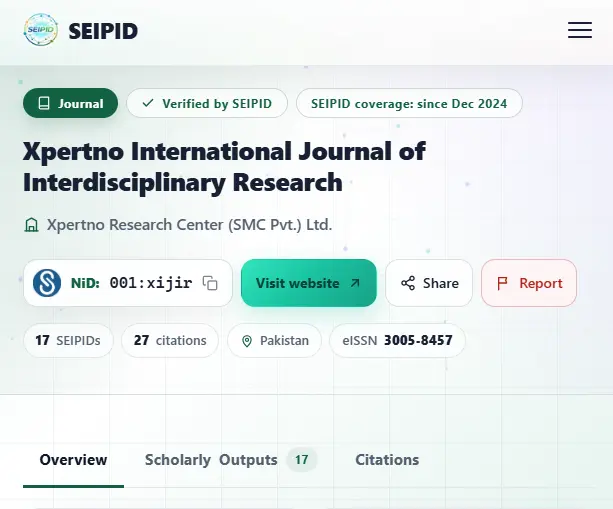
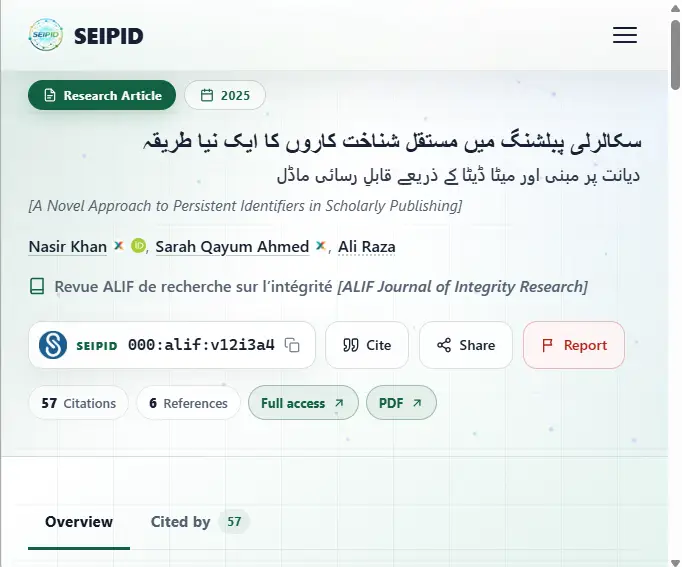
Explore a public record for a platform’s persistent NiD and a public record for an individual work’s persistent SEIPID. Each brings together its registered identity, metadata and relevant scholarly information.
NiD Public Record
A platform’s registered information, scholarly outputs and available public citation insights.
How Does SEIPID Work Alongside Website URLs and DOIs?
SEIPID supports existing publishing and repository workflows, including works that already have a DOI.
A Website URL
A URL points to a specific webpage or file. When that address changes, continued access depends on redirects or updated links maintained by the website owner.
A DOI
A DOI identifies a work and links to its registered destination. Registration arrangements, available services and charges depend on the registration agency or service provider.
SEIPID
SEIPID provides a persistent NiD for the scholarly platform and a persistent SEIPID for each registered work, together with independent public records, source-link maintenance, citation discovery, scholarly analysis and shared management.
ⓘA work can have both a DOI and a persistent SEIPID. Record its existing DOI in the metadata so readers and scholarly services can recognise the connections between its identifiers.
Your platform, your control
What Remains Under Your Control?
Your organisation and the relevant rights holders retain control of the source website, full text, publishing decisions and editorial processes. Your authorised team maintains descriptive metadata and registered source links through SEIPID Diwan.
SEIPID maintains the persistent identifiers and independent public metadata records. Public descriptive metadata is reusable under CC0 1.0; the scholarly work retains its own rights and licence. Peer review and assessment of research quality remain with the responsible scholarly organisations.
Clear service arrangements
Choose Access That Fits Your Scholarly Work
Registration services and access to deeper analysis have their own published arrangements.
Registration and Management
Account-based annual service fees define namespace capacity, team access and included benefits. Persistent SEIPIDs are purchased separately at the applicable rate. Add-ons and upgrades support growing registration needs.
Selected Idraak metrics and analysis are free on public records. Authorised users can access free Resolution & Link Health Analysis in Diwan. Paid Idraak Plus access provides deeper analysis within Idraak through Diwan or the authorised SEIPID API after purchase.
SEIPID helps your scholarly platform and its research become easier to discover, understand, cite, and reuse. Structured public metadata, including JSON-LD, supports search engine indexing and AI-powered discovery, helping compatible systems recognise your platform, its outputs, contributors, and scholarly connections.
Your platform receives its own persistent Namespace Identifier (NiD) and dedicated public profile. Each registered scholarly output receives its own SEIPID and independent metadata record, preserving its identity and discoverability when the original website changes or becomes unavailable.
Readers gain ready-to-use citations, sharing tools, and metadata downloads. Your team gains citation insights, source-link monitoring, and centralised management of multiple namespaces and their outputs—with separate logins and assigned permissions under one account.
What happens if the original website becomes unavailable?
When a registered output’s source becomes inaccessible, its SEIPID resolves to the corresponding public metadata record maintained by SEIPID. Readers can still identify the work, view its descriptive information, and access citation and metadata tools. SEIPID preserves the metadata record; the source platform remains responsible for the full-text files.
Does SEIPID support discovery through search engines and Google Scholar?
SEIPID publishes dedicated public records with structured, machine-readable metadata, helping search engines and compatible scholarly discovery systems identify platforms, scholarly outputs, contributors, and their relationships.
Google Scholar applies its own content and technical requirements. Inclusion, ranking, and update timing remain decisions of the external discovery service.
Can SEIPID metadata be read by AI, LLMs, and data-mining tools?
Yes. SEIPID provides structured, machine-readable public metadata, including JSON-LD, helping compatible AI systems, LLM-based tools, and data-mining applications identify scholarly platforms and outputs and interpret their authorship, publication details, and scholarly relationships.
Persistent NiDs identify registered platforms, while SEIPIDs identify individual scholarly outputs. These identifiers help systems distinguish records and connect related information. Public metadata is available under CC0, supporting reuse, analysis, and integration.
Is SEIPID a DOI, and can a work have both?
SEIPID is an independent persistent identifier system that offers an alternative to DOI-based identification. The same scholarly output can have both a SEIPID and a DOI. Its existing DOI can be recorded in the SEIPID metadata to maintain the connection between the identifiers.
SEIPID charges an annual service fee for your account’s selected plan. SEIPID credits are purchased separately at the applicable rate and can be used across your approved namespaces. The pricing page lists current fees, purchase allowances, namespace capacity, team access, and available offers.